

脑神经概述
12 pairs of cranial nerves are linked directly to the brain, without having to pass through the spinal cord. Therefore, these allow sensory information to pass from the organs of the head, such as the ears and eyes, to the brain.
These also convey motor information from the brain to these organs, such as giving directions to the mouth to move in order to eat or speak.
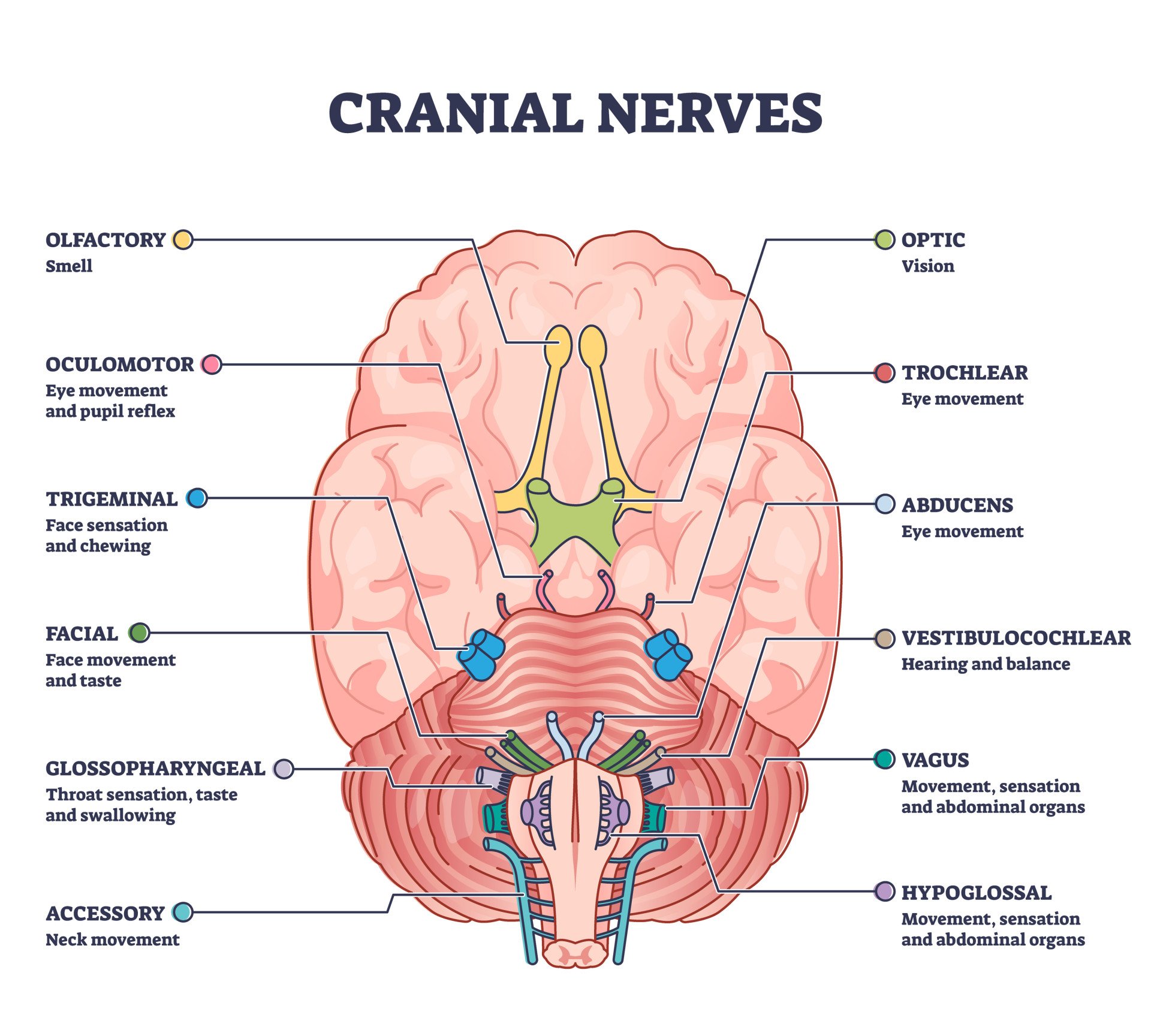
All the cranial nerves originate from nuclei [clusters of nerve cell bodies in the brain or spinal cord] in the brain. Two cranial nerves, the optic nerve and the olfactory nerve, originate from the cerebrum [the largest part of the brain]. The accessory nerve has a nucleus in the spinal cord.
The rest of the cranial nerves originate from the brain stem, the lower part of the brain that controls basic functions. These can arise from a specific brain stem region, either the midbrain, pons, or medulla, or from a junction between two parts.
The functions of the cranial nerves are typically described as either sensory or motor in function. The sensory cranial nerves are involved with the senses, search as sight, smell, hearing, and touch.
Whereas the motor nerves control the movements and functions of muscles and glands, cranial nerves supply sensory and motor information to areas of the head and neck.
One nerve, the vagus nerve, extends beyond the neck to the thoracic and abdominal organs.
- Cranial Nerve Modalities Sensory and Motor Functions
- Types of Cranial Nerves
- Common Disorders Affecting Cranial Nerves
Cranial Nerve Modalities: Sensory and Motor Functions
Each type of cranial nerve has either sensory functions, motor functions, or both, known as modalities.
The types of information that cranial nerves transport can all differ.
There are seven types of modalities of information that can be sent, with three of these being unique to cranial nerves.
Sensory modalities
- General visceral sensory (GVS) – this is general sensation from internal organs (also known as viscera).
- General somatic sensory (GSS) – this is general sensation from the skin.
- Special somatic sensory (SSS) – unique to cranial nerves, these are senses originating from ectoderm (the outermost layer of cells or tissue).
- Special visceral sensory (SVS) – unique to cranial nerves, these are senses originating from endoderm (the innermost layer of cells or tissue).
Motor modalities
- General somatic motor (GSM) – this relates to skeletal muscles.
- General visceral motor (GVM) – this relates to smooth muscles of the gut and autonomic functions [involuntary, automatic bodily processes].
- Special visceral motor (SVM) – unique to cranial nerves, this relates to muscle origination from pharyngeal arches (of the throat and nasal cavity).
Types of Cranial Nerves
There are 12 pairs of cranial nerves attached to the brain. The cranial nerves are named after the body parts that they serve, and are also assigned Roman numerals, based off their location from front to back.
Mnemonic for Function of Cranial Nerves:
Oh, Oh, Oh, To Touch And Feel Very Good Velvet, such- A Heaven
Another mnemoic is as follows:
- Old: Olfactory
- Operators: Optic
- Occasionally: Oculomotor
- Troubleshoot: Trochlear
- Tricky: Trigeminal
- Abducted: Abducens
- Family: Facial
- Veterans: Vestibulocochlear
- Galloping: Glossopharyngeal
- Valiantly: Vagus
- Across: Accessory
- History: Hypoglossal
Mnemonic for Order of Cranial Nerves:
Some Say Marry Money But My Brother Says Big Brains Matter More
- Cranial I: Sensory
- Cranial II: Sensory
- Cranial III: Motor
- Cranial IV: Motor
- Cranial V: Both (sensory & motor)
- Cranial VI: Motor
- Cranial VII: Both (sensory & motor)
- Cranial VIII: Sensory
- Cranial IX: Both (sensory & motor)
- Cranial X: Both (sensory & motor)
- Cranial XI: Motor
- Cranial XII: Motor
Ⅰ. Olfactory nerve
The olfactory nerves carry smell information. The smell molecules in the nasal cavity trigger nerve impulses that pass along this nerve to the olfactory bulb, where smell is processed, then onto limbic areas.
The type of modality is sensory, of the special visceral sensory variety.
Damage to the olfactory nerve can cause a loss of the sense of smell.
Ⅱ. Optic nerve
The optic nerves carry visual information from the eyes to the brain.. Visual information from the retinas of the eyes is conveyed to the brain by the optic nerves at the back of the eye.
Both optic nerves from the eyes meet to form something called an optic chiasm [where the optic nerves cross at the brain]. At the optic chiasm, signals from both fields of vision are sent to opposite sides of the brain via two separate optic tracts.
These signals will then eventually reach the visual cortex at the back of the brain.
The type of modality of the optic nerve is sensory, of the special somatic sensory variety.
Damage to the optic nerve can cause vision loss or blurred vision.
Ⅲ. Oculomotor nerve
The oculomotor nerve carries visual information. This nerve provides motor function to most of the muscles around the eyes to help them move and focus on objects.
This nerve also functions in pupillary response to help control the size of the pupils as it responds to light, dilating and constricting the pupils.
This nerve originates from the front of the midbrain, which is part of the brain stem, moving from this area until it reaches the area of the eye sockets.
The modality of this cranial nerve is motor, of the general somatic and general visceral motor variety.
Damage to the oculomotor nerve can cause drooping of the eyelid, double vision, and difficulty moving the eye.
Ⅳ. Trochlear nerve
The trochlear nerve controls the superior oblique muscles, which are the muscles that are responsible for downward, outward, and inward eye movements.
This nerve travels from the back of the midbrain to the eye sockets, where it stimulates the superior oblique muscles.
The trochlear nerve is motor in modality of the general somatic motor variety.
Damage to the trochlear nerve can cause difficulty looking down or reading, and double vision when walking downstairs.
Ⅴ. Trigeminal nerve
The trigeminal nerve is the largest of the cranial nerves and can be further divided into three divisions: ophthalmic, maxillary, and mandibular.
- The ophthalmic division sends information from the scalp, forehead, and upper eyelids (the upper parts of the head) and is sensory in modality, of the general somatic sensory variety.
- The maxillary division sends information from the middle of the head, such as cheeks, lower eyelids, upper lip, and nasal cavity. This is also sensory or the general somatic sensory variety.
- The mandibular division sends both sensory and motor information of the general somatic sensory and special visceral motor modalities. This sends information from the lower parts of the head, such as the tongue, lower lip, chin, and jaw.
Damage to the trigeminal nerve can cause severe facial pain or loss of feeling in parts of the face.
Ⅵ. Abducens nerve
The abducens nerve is another nerve controlling a muscle of the eye, called the lateral rectus muscle. This muscle is responsible for outward eye movements such as looking to the side.
This nerve originates in the pons [part of the brain stem that acts as a bridge between the cerebrum and cerebellum] and travels to the eye socket to control this muscle.
This nerve sends motor information about the general somatic motor modality.
Damage to the abducens nerve can cause difficulty moving the eye outward and double vision.
Ⅶ. Facial nerve
Facial nerves have both sensory and motor functions, such as collecting information from the taste buds of the tongue, controlling muscle movements required for facial expressions, and supplying glands that produce saliva and secrete tears.
Facial nerves originate from the pons area of the brainstem, where it has both motor and sensory roots, before fusing together to form the facial nerve.
The sensations from part of the external ear are of the general somatic sensory modality, taste is part of the special visceral sensory modality, the muscles of facial expressions are part of the special visceral sensory modality, and the lacrimal and mucous glands of the eyes, mouth, and nose are of the general visceral motor modality.
Damage to the facial nerve can cause weakness or paralysis of the muscles on one side of the face.
Ⅷ. Vestibulocochlear nerve
The vestibulocochlear nerve carries information about hearing and consists of two divisions: cochlear and vestibular.
- The vestibular branch collects information regarding the inner ear and head orientation and balance.
- The cochlear branch is concerned with sound and hearing signals from the ear, detecting vibrations from a sound’s volume and pitch.
This information is sensory to the special somatic sensory modality.
Damage to the vestibulocochlear nerve can cause hearing loss, dizziness, or balance problems.
Ⅸ. Glossopharyngeal nerve
The glossopharyngeal nerve has both motor and sensory functions originating from a part of the brainstem called the medulla oblongata [which connects the brain with the spinal cord], extending into the neck and throat.
This nerve sends sensory information from the external ear and middle ear cavity (general somatic sensory modality), the back part of the tongue (special visceral sensory modality), and from the sinuses at the back of the throat (general visceral sensory modality).
This nerve also sends motor information from two salivary glands called parotid glands (general visceral motor modality), and movement from a muscle at the back of the throat involved in swallowing called the stylopharyngeus (special visceral motor modality).
Damage to the glossopharyngeal nerve can cause difficulty swallowing or loss of taste at the back of the tongue.
Ⅹ. Vagus nerve
The vagus nerve has a variety of functions and is the longest and most branched of all the cranial nerves, with sensory, motor, and autonomic fibers.
It receives sensory information from the ear canal as well as the larynx and pharynx, which are parts of the throat (general somatic sensory modality), information from the organs of the chest and trunk such as the heart and intestines (general visceral sensory modality), and a sense of taste from the root of the tongue (special visceral sensory modality).
It also receives motor information from the smooth muscles of parts of the throat (general visceral motor modality), as well as most of the muscles of the throat (special visceral motor modality).
Damage to the vagus nerve can cause hoarseness, difficulty speaking or swallowing, and problems with digestion.
Ⅺ. Spinal accessory nerve
The spinal accessory nerve has motor functions associated with the muscles and movements of the head, neck, and shoulders. This also stimulates the muscles of the larynx and pharynx, which are responsible for swallowing.
Movements of the head and shoulders are of the general somatic motor modality, whereas the internal movements are of the special visceral motor modality.
Damage to the spinal accessory nerve can cause difficulty shrugging the shoulders or turning the head.
Ⅻ. Hypoglossal nerve
The hypoglossal nerve is responsible for most of the movements in the tongue. These originate in the medulla oblongata and move down into the jaw, reaching the tongue.
This nerve is of the general somatic motor modality.
Damage to the hypoglossal nerve can cause difficulty moving the tongue and problems with speech and swallowing.
Common Disorders Affecting Cranial Nerves
As cranial nerves play a vital role in the proper functioning of the face, head, and neck, damage to these nerves could be detrimental.
Cranial nerve damage can be the result of many causes, such as head trauma. Other causes include infections, stroke, brain tumors, diabetes, and high blood pressure.
Since many of the nerves run over the surface of the skull and are only protected by the muscles and tissues of the face, this makes them more vulnerable to injury.
Symptoms of damage to cranial nerves depend on the nerves that are damaged. For instance, damage to the optic nerves may affect vision, even blindness in the worst conditions.
Damage to the olfactory nerve may affect the sense of smell, as well as the ability to taste food, due to smell being an important factor in taste. If the facial nerve is damaged, this may impair the ability to make facial expressions on one side of the face.
More generally, damage to cranial nerves may result in the following symptoms:
- Loss of sensation in a part of the face
- Weakness
- Numbness of the face
- Pain
- Tingling sensation
- Changes in vision
- Weak or paralyzed muscles
Some cranial neuropathies may go away independently, but some could be more permanent or life-threatening. Medication or physical/occupational therapy may be required to assist someone suffering from cranial nerve damage.
Preventative measures to avoid cranial nerve damage include following a healthy lifestyle of regular exercise, eating a balanced diet, maintaining a healthy weight, and not smoking.
Similarly, avoiding the risk of diabetes, aiming to lower blood pressure, and reducing the risk of head injury can all help to avoid cranial nerve damage.
脑神经概述
12对脑神经直接与大脑相连,无需通过脊髓。因此,这些允许感官信息从头部器官(例如耳朵和眼睛)传递到大脑。
它们还将运动信息从大脑传递到这些器官,例如指示嘴巴移动以进食或说话。
所有脑神经都起源于大脑中的细胞核(大脑或脊髓中的神经细胞体簇)。两条脑神经,视神经和嗅神经,起源于大脑[大脑的最大部分]。副神经在脊髓中有一个核。
其余的脑神经起源于脑干,即控制基本功能的大脑下部。这些可能来自特定的脑干区域,或者是中脑、脑桥或延髓,或者来自两个部分之间的连接处。
脑神经的功能通常被描述为感觉功能或运动功能。感觉脑神经与感觉有关,包括视觉、嗅觉、听觉和触觉。
运动神经控制肌肉和腺体的运动和功能,而颅神经则向头部和颈部区域提供感觉和运动信息。
其中一根神经,即迷走神经,延伸到颈部以外的胸部和腹部器官。
脑神经模式:感觉和运动功能
每种类型的脑神经都具有感觉功能、运动功能或两者兼而有之,称为模态。
脑神经传输的信息类型可能各不相同。
可以发送七种类型的信息,其中三种是脑神经所独有的。
感觉方式
- 一般内脏感觉 (GVS) – 这是内脏器官(也称为内脏)的一般感觉。
- 一般躯体感觉 (GSS) – 这是皮肤的一般感觉。
- 特殊躯体感觉 (SSS) – 脑神经独有的感觉,这些感觉源自外胚层(细胞或组织的最外层)。
- 特殊内脏感觉 (SVS) – 脑神经独有的感觉,这些感觉源自内胚层(细胞或组织的最内层)。
运动方式
- 一般躯体运动 (GSM) – 这与骨骼肌有关。
- 一般内脏运动 (GVM) – 这与肠道平滑肌和自主功能 [不自主、自动的身体过程] 相关。
- 特殊内脏运动(SVM) ——脑神经所特有,与源自咽弓(喉咙和鼻腔)的肌肉有关。
脑神经的类型
有12对脑神经附着在大脑上。脑神经以其所服务的身体部位命名,并根据其从前到后的位置分配罗马数字。
脑神经功能助记符:
哦,哦,哦,触摸并感觉非常好的天鹅绒,这样的天堂
另一种助记符如下:
- 旧:嗅觉
- 运营商:光学
- 偶尔:动眼神经
- 故障排除:滑车
- 棘手:三叉神经
- 被绑架
- 家庭:面部护理
- 退伍军人:前庭耳蜗
- 奔腾:舌咽
- 勇敢:迷走神经
- 横跨:配件
- 历史:舌下
脑神经顺序助记符:
有人说嫁给金钱,但我哥哥说聪明才智更重要
- 颅骨 I:感觉
- 颅骨 II:感觉
- 颅骨 III:电机
- 颅骨 IV:电机
- 颅骨 V:两者(感觉和运动)
- 颅骨六:电机
- 颅骨 VII:两者(感觉和运动)
- 颅骨 VIII:感觉
- 颅脑 IX:两者(感觉和运动)
- 颅骨 X:两者(感觉和运动)
- 颅骨十一:电机
- 颅骨十二:马达
Ⅰ.嗅觉神经
嗅觉神经携带气味信息。鼻腔中的气味分子触发神经冲动,沿着该神经传递到嗅球,在那里处理气味,然后到达边缘区域。
形态类型是感觉,属于特殊的内脏感觉类型。
嗅觉神经受损会导致嗅觉丧失。
二.视神经
视神经将视觉信息从眼睛传送到大脑。来自眼睛视网膜的视觉信息通过眼睛后部的视神经传送到大脑。
眼睛的两条视神经相遇形成称为视交叉(视神经在大脑处交叉的地方)的东西。在视交叉处,来自两个视野的信号通过两个独立的视束发送到大脑的相对两侧。
这些信号最终将到达大脑后部的视觉皮层。
视神经的形态类型是感觉的,属于特殊的躯体感觉类型。
视神经损伤会导致视力丧失或视力模糊。
三.动眼神经
动眼神经携带视觉信息。该神经为眼睛周围的大多数肌肉提供运动功能,帮助它们移动并聚焦于物体。
该神经还在瞳孔反应中起作用,以帮助控制瞳孔的大小,因为它对光做出反应,扩张和收缩瞳孔。
该神经起源于中脑前部,是脑干的一部分,从中脑区域移动直至到达眼窝区域。
该脑神经的形态是运动,属于一般躯体运动和一般内脏运动类型。
动眼神经损伤会导致眼睑下垂、复视和眼球移动困难。
四.完整的神经
滑车神经控制上斜肌,这些肌肉负责向下、向外和向内的眼球运动。
这条神经从中脑后部延伸到眼窝,刺激上斜肌。
滑车神经以一般躯体运动类型的方式进行运动。
滑车神经损伤会导致低头或阅读困难,以及下楼时出现复视。
Ⅴ.三叉神经
三叉神经是最大的脑神经,可进一步分为三个部分:眼神经、上颌神经和下颌神经。
- 眼科从头皮、前额和上眼睑(头部的上部)发送信息,并且在形态上属于一般躯体感觉类型的感觉。
- 上颌部从头部中部发送信息,例如脸颊、下眼睑、上唇和鼻腔。这也是感觉或一般躯体感觉变化。
- 下颌部发送一般躯体感觉和特殊内脏运动方式的感觉和运动信息。它从头部的下部发送信息,例如舌头、下唇、下巴和下巴。
三叉神经损伤会导致严重的面部疼痛或面部某些部位失去知觉。
Ⅵ.外展神经
外展神经是另一种控制眼睛肌肉的神经,称为外直肌。该肌肉负责向外的眼球运动,例如看向侧面。
该神经起源于脑桥(脑干的一部分,充当大脑和小脑之间的桥梁),并传播到眼窝以控制这块肌肉。
该神经发送有关一般躯体运动方式的运动信息。
外展神经受损会导致眼睛向外移动困难和复视。
Ⅶ.面神经
面部神经同时具有感觉和运动功能,例如从舌头的味蕾收集信息,控制面部表情所需的肌肉运动,并供应产生唾液和分泌眼泪的腺体。
面神经起源于脑干的脑桥区域,这里有运动根和感觉根,然后融合在一起形成面神经。
外耳部分的感觉属于一般躯体感觉模态,味觉属于特殊内脏感觉模态,面部表情肌肉属于特殊内脏感觉模态,眼、口、鼻的泪腺和粘液腺属于一般内脏运动模态。
面神经损伤会导致面部一侧肌肉无力或麻痹。
Ⅷ.前庭蜗神经
前庭蜗神经携带有关听力的信息,由两个部分组成:耳蜗和前庭。
- 前庭分支收集有关内耳和头部方向和平衡的信息。
- 耳蜗分支与来自耳朵的声音和听觉信号有关,从声音的音量和音调中检测振动。
该信息是特殊躯体感觉方式的感觉。
前庭蜗神经损伤会导致听力丧失、头晕或平衡问题。
Ⅸ.舌咽神经
舌咽神经具有运动和感觉功能,起源于脑干的延髓部分(连接大脑和脊髓),延伸到颈部和喉咙。
该神经从外耳和中耳腔(一般躯体感觉方式)、舌头后部(特殊内脏感觉方式)以及喉咙后部的鼻窦(一般内脏感觉方式)发送感觉信息。
该神经还从称为腮腺(一般内脏运动方式)的两个唾液腺发送运动信息,并从喉咙后部参与吞咽的称为茎咽肌(特殊内脏运动方式)的肌肉发送运动信息。
舌咽神经受损会导致吞咽困难或舌后部味觉丧失。
Ⅹ.迷走神经
迷走神经具有多种功能,是所有脑神经中最长、分支最多的,具有感觉、运动和自主神经纤维。
它从耳道以及喉部和咽部(喉咙的一部分)接收感觉信息(一般躯体感觉方式),从胸部和躯干器官如心脏和肠道接收信息(一般内脏感觉方式),以及来自舌根的味觉(特殊内脏感觉方式)。
它还从喉咙部分的平滑肌(一般内脏运动方式)以及喉咙的大部分肌肉(特殊内脏运动方式)接收运动信息。
迷走神经损伤会导致声音嘶哑、说话或吞咽困难以及消化问题。
Ⅺ.脊髓副神经
脊髓副神经具有与头部、颈部和肩部的肌肉和运动相关的运动功能。这也会刺激负责吞咽的喉部和咽部的肌肉。
头部和肩部的运动属于一般躯体运动模式,而内部运动属于特殊内脏运动模式。
脊髓副神经受损会导致耸肩或转动头部困难。
Ⅻ.舌下神经
舌下神经负责舌头的大部分运动。它们起源于延髓,向下移动到下颌,到达舌头。该神经属于一般躯体运动模式。舌下神经受损会导致
舌头移动困难以及言语和吞咽问题。
影响脑神经的常见疾病
由于脑神经在面部、头部和颈部的正常功能中发挥着至关重要的作用,因此这些神经的损伤可能是有害的。
脑神经损伤可能是多种原因造成的,例如头部外伤。其他原因包括感染、中风、脑肿瘤、糖尿病和高血压。
由于许多神经遍布头骨表面,仅受到面部肌肉和组织的保护,这使得它们更容易受伤。
脑神经损伤的症状取决于受损的神经。例如,视神经损伤可能会影响视力,在最坏的情况下甚至会导致失明。
嗅觉神经受损可能会影响嗅觉以及品尝食物的能力,因为气味是味觉的重要因素。如果面部神经受损,可能会损害面部一侧的面部表情能力。
更一般地说,颅神经损伤可能会导致以下症状:
- 面部某部分失去知觉
- 弱点
- 脸部麻木
- 疼痛
- 刺痛感
- 视力变化
- 肌肉无力或瘫痪
有些颅神经病变可能会独立消失,但有些可能会是永久性的或危及生命。可能需要药物或物理/职业治疗来帮助患有脑神经损伤的人。
避免脑神经损伤的预防措施包括遵循定期锻炼的健康生活方式、均衡饮食、保持健康体重和不吸烟。
同样,避免患糖尿病的风险、降低血压和减少头部受伤的风险都有助于避免脑神经损伤。