

周围神经系统 (PNS):组成部分和功能
The peripheral nervous system (PNS) is critical for connecting the central nervous system (CNS) to the rest of the body. It is essential for bodily functions such as movement, sensation, and autonomic processes.

What does the PNS do?
The PNS has many essential functions throughout the body:
- Sensation: Sensory information is carried from the eyes, ears, nose, tongue, and skin to the brain. For example, when you smell food, this information is carried from the nose to the brain.
- Movement: The PNS carries signals that allow for voluntary movements such as walking, and maintaining posture, and for reflex movements such as automatically moving a hand away from a hot surface.
- Involuntary processes: Vital, unconscious processes such as heartbeat and breathing are controlled by the PNS.
- Digestion: The PNS sends messages to the digestive system to keep food moving along, for example, by helping to produce saliva when food is presented.
The functions of the PNS are controlled by different substructures which will be explained in the next section.
Parts and Divisions of the Peripheral Nervous System
The peripheral nervous system (PNS) is divided into two main branches, each with distinct roles:
These subdivisions help regulate both voluntary and involuntary body functions.

Somatic Nervous System
The somatic nervous system is responsible for conscious, voluntary movements, like walking, talking, or typing. It includes two types of nerves:
- Sensory neurons (afferent neurons): Carry information from sensory organs (skin, eyes, ears, etc.) to the central nervous system (CNS).
Example: When you touch a hot stove, sensory neurons alert the brain. - Motor neurons (efferent neurons): Transmit signals from the CNS to skeletal muscles, enabling movement.
Example: Your brain sends motor commands that help you lift a cup or run.
This system also controls reflex actions through a structure called the reflex arc, which allows for fast, automatic responses without involving the brain.
Autonomic Nervous System
The autonomic nervous system manages involuntary processes—functions you don’t consciously control, like heartbeat, digestion, or breathing. It is further divided into two parts:
- Sympathetic nervous system (“fight or flight”):
Prepares the body for stressful situations. It increases heart rate, opens airways, dilates pupils, and slows digestion. - Parasympathetic nervous system (“rest and digest”):
Calms the body after stress. It reduces heart rate, promotes digestion, and restores energy balance.
Together, the SNS and ANS allow the PNS to handle both physical movement and automatic life-sustaining processes.

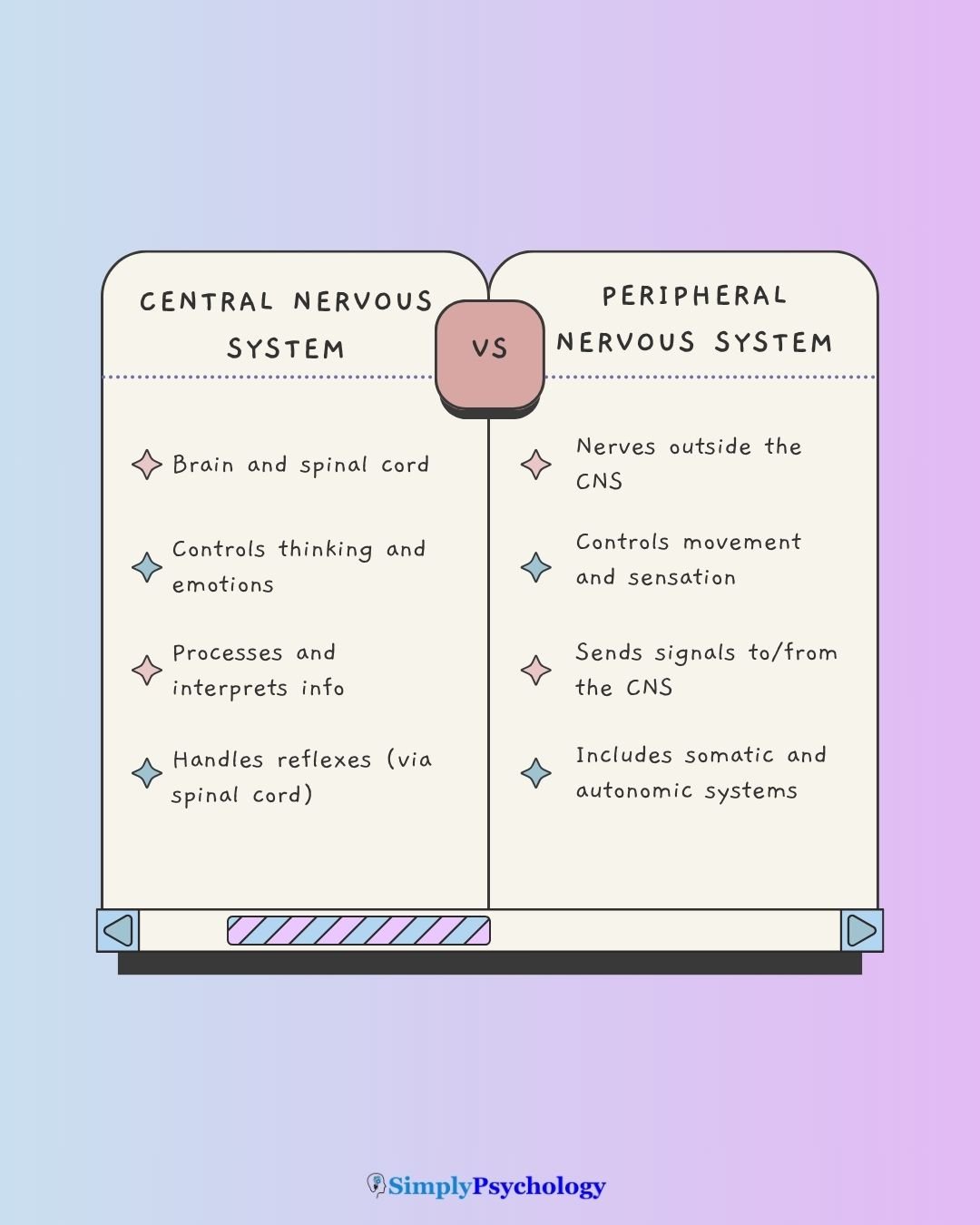
Central nervous system vs peripheral nervous system
The central nervous system (CNS) and peripheral nervous system (PNS) serve distinct but complementary roles.
The CNS, consisting of the brain and spinal cord, acts as the body’s command center and is protected by bone and protective membranes.
The PNS comprises nerves branching throughout the body, lacking bony protection and thus more vulnerable to injury.
While the CNS processes and makes decisions, the PNS functions as a messenger network through sensory and motor neurons.
CNS neurons also have limited regenerative capacity, making injuries often permanent. PNS neurons, however, can regenerate under certain conditions, allowing for potential recovery from peripheral nerve damage.
Nerves in the Peripheral Nervous System
The PNS is made up of nerve cells (neurons) that carry messages back and forth between the CNS and the muscles, organs, and senses in the body’s periphery.

Within the PNS, some nerves are attached to the spinal cord (spinal nerves), and others are attached directly to the brain (cranial nerves).
Spinal nerves
There are 31 pairs of spinal nerves, which emerge from the spinal cord and branch out to serve different areas of the body. These nerves carry:
- Sensory signals from the skin, muscles, and organs to the spinal cord and brain
- Motor commands from the brain and spinal cord to the muscles and glands

Types of spinal nerves (grouped by region):
- 8 cervical nerves, which serve the chest, head, neck, shoulders, arms, and hands (called C1-C8).
- 12 thoracic nerves, which serve the back, abdominal muscles, and intercostal muscles (called T1 – T12).
- 5 lumbar nerves, which serve the lower abdomen, thighs, and legs (called L1-L5).
- 5 sacral nerves, which serve the legs, feet, and genital areas (called S1-S5).
- 1 coccygeal pair of nerves (called Co1).
These nerves exit the spinal column through openings in the vertebrae and form a vast network that links every part of the body to the nervous system.
Example: The Sciatic Nerve
The sciatic nerve, which extends from the lower spine down to the toes, is the longest nerve in the human body.
It plays a major role in leg movement and is commonly associated with conditions like sciatica.
Cranial nerves
Unlike spinal nerves, cranial nerves connect directly to the brain, bypassing the spinal cord.
There are 12 pairs of cranial nerves, and most are involved in sensory and motor functions of the head and neck.
Functions of Cranial Nerves:
- Transmit sensory input from the eyes, ears, nose, tongue, and face
- Send motor signals to muscles involved in facial expression, chewing, swallowing, and speech

For example, when eating:
- Cranial nerves help you chew and swallow (motor function)
- They also relay taste signals back to the brain (sensory function)
There are 12 pairs of cranial nerves attached to the brain:
- Olfactory nerves are sensory nerves related to the sense of smell.
- Optic nerves are sensory nerves related to the sense of sight.
- Oculomotor, trochlear, and abducens nerves are motor nerves responsible for regulating voluntary eye movements.
- Vestibulocochlear nerves are sensory nerves related to the sense of hearing, linked with sound, orientation, and balance.
- Glossopharyngeal and hypoglossal nerves are sensory and motor nerves responsible for tongue muscle movements and sense of taste.
- Vagus nerves are both sensory and motor nerves responsible for movements of the lower head, throat, neck, chest, and abdomen, as well as autonomic functions such as breathing and heart rate.
- Spinal accessory nerves are both sensory and motor nerves responsible for the muscle and movements of the head, neck, and shoulders.
- Facial nerves are sensory and motor nerves related to the taste buds and movements of the face (facial expressions).
- Trigeminal nerves are sensory and motor nerves that carry signals from the eyes, teeth, and face, as well as impulses from the lower jaw and muscles involved with chewing.
Why the Peripheral Nervous System Matters
The peripheral nervous system (PNS) is not just a conduit for signals between the brain and body; it’s a dynamic network essential for survival, adaptation, and overall well-being.
1. It Powers Everyday Actions
The PNS lets you walk, grip a pencil, feel textures, or react quickly to danger. These responses happen through sensory and motor nerves working in sync with the brain and spinal cord.
2. It Keeps Your Body in Balance
The autonomic division of the PNS regulates involuntary processes like heart rate, blood pressure, and digestion.
This helps maintain homeostasis—your body’s internal balance—even during stress or illness.
3. It Can Regenerate After Injury
Unlike the central nervous system, the PNS has some ability to repair itself. Cells like Schwann cells help guide the healing of damaged nerves, improving chances of recovery after injury.
4. It Reflects Your Overall Health
Tingling, numbness, or muscle weakness may indicate larger issues like diabetes, autoimmune disorders, or nutritional deficiencies. Tracking PNS symptoms can support early diagnosis of systemic problems.
5. It Includes the “Second Brain”
The enteric nervous system, part of the PNS, controls digestion independently of the brain. It’s so influential that scientists call it the “second brain.”
It even plays a role in mood regulation and immune function.
Sources
Dorland, W. A. N. (2011). Dorland’s Illustrated Medical Dictionary E-Book. Elsevier Health Sciences.
Eyesenck, M. W. (2012). Simply Psychology. New York: Taylor & Francis.
Goldstein, D. S. (2010). Adrenal responses to stress. Cellular and Molecular Neurobiology, 30 (8), 1433-1440.
Martin, G. N., Carlson, N. R., & Buskist, W. (2009). Psychology, 4th European edition. Harlow: Pearson Education, 723-725.

周围神经系统 (PNS):组成部分和功能
周围神经系统 (PNS) 对于连接中枢神经系统 ( CNS ) 与身体其他部位至关重要。它对于运动、感觉和自主过程等身体功能至关重要。
三七总皂苷有什么作用?
PNS 在全身具有许多重要功能:
- 感觉:感觉信息从眼睛、耳朵、鼻子、舌头和皮肤传送到大脑。例如,当你闻到食物的味道时,这些信息就会从鼻子传递到大脑。
- 运动: PNS 携带的信号允许自主运动(例如行走和保持姿势)以及反射运动(例如自动将手移离热表面)。
- 非自愿过程:重要的、无意识的过程,如心跳和呼吸,由三七总皂甙控制。
- 消化:三七总皂甙向消化系统发送信息以保持食物的移动,例如,在食物出现时帮助产生唾液。
PNS 的功能由不同的子结构控制,这将在下一节中解释。
周围神经系统的部分和分区
周围神经系统 (PNS) 分为两个主要分支,每个分支都有不同的作用:
这些细分有助于调节自愿和非自愿的身体功能。
躯体神经系统
躯体神经系统负责有意识的、随意的运动,如行走、说话或打字。它包括两种类型的神经:
- 感觉神经元(传入神经元):将信息从感觉器官(皮肤、眼睛、耳朵等)传送到中枢神经系统(CNS)。
示例:当您触摸热炉时,感觉神经元会向大脑发出警报。 - 运动神经元(传出神经元):将信号从中枢神经系统传输到骨骼肌,从而实现运动。
示例:您的大脑发送运动命令来帮助您举起杯子或跑步。
该系统还通过一种称为反射弧的结构控制反射动作,该结构可以在不涉及大脑的情况下实现快速、自动的反应。
自主神经系统
自主神经系统管理非自愿过程,即您无法有意识控制的功能,例如心跳、消化或呼吸。它又分为两部分:
- 交感神经系统(“战斗或逃跑”):
让身体做好应对压力情况的准备。它会增加心率、打开呼吸道、扩张瞳孔并减缓消化。 - 副交感神经系统(“休息和消化”):
压力后使身体平静。它可以降低心率、促进消化并恢复能量平衡。
SNS 和 ANS 共同使 PNS 能够处理身体运动和自动维持生命的过程。
中枢神经系统与周围神经系统
中枢神经系统(CNS)和周围神经系统(PNS)发挥着不同但互补的作用。
中枢神经系统由大脑和脊髓组成,充当身体的指挥中心,并受到骨骼和保护膜的保护。
PNS 由分布在全身的神经组成,缺乏骨骼保护,因此更容易受伤。
在中枢神经系统处理和做出决策的同时,三七总神经系统通过感觉和运动神经元发挥信使网络的作用。
中枢神经系统神经元的再生能力也有限,导致损伤往往是永久性的。然而,PNS 神经元在某些条件下可以再生,从而有可能从周围神经损伤中恢复。
周围神经系统的神经
PNS 由神经细胞(神经元)组成,在 CNS 和身体周围的肌肉、器官和感觉之间来回传递信息。
在三七总皂甙内,一些神经附着在脊髓上(脊神经),而另一些神经则直接附着在大脑上(脑神经)。
脊髓神经
有31 对脊神经,它们从脊髓中伸出并分支以服务于身体的不同部位。这些神经携带:
- 从皮肤、肌肉和器官到脊髓和大脑的感觉信号
- 从大脑和脊髓到肌肉和腺体的运动命令
脊神经的类型(按区域分组):
- 8 条颈神经,服务于胸部、头部、颈部、肩膀、手臂和手(称为 C1-C8)。
- 12 条胸神经,服务于背部、腹部肌肉和肋间肌(称为 T1 – T12)。
- 5 腰神经,服务于下腹部、大腿和小腿(称为 L1-L5)。
- 5 条骶神经,服务于腿、脚和生殖器区域(称为 S1-S5)。
- 1对尾骨神经(称为 Co1)。
这些神经通过椎骨上的开口离开脊柱,形成一个巨大的网络,将身体的每个部分与神经系统连接起来。
示例:坐骨神经
坐骨神经从下脊柱一直延伸到脚趾,是人体最长的神经。
它在腿部运动中发挥着重要作用,通常与坐骨神经痛等疾病有关。
脑神经
与脊神经不同,脑神经绕过脊髓直接连接到大脑。
脑神经有12对,大部分参与头颈部的感觉和运动功能。
脑神经的功能:
- 传输来自眼睛、耳朵、鼻子、舌头和面部的感官输入
- 向涉及面部表情、咀嚼、吞咽和言语的肌肉发送运动信号
例如,吃饭时:
- 脑神经帮助您咀嚼和吞咽(运动功能)
- 它们还将味觉信号传递回大脑(感觉功能)
大脑有 12 对脑神经:
- 嗅觉神经是与嗅觉有关的感觉神经。
- 视神经是与视觉相关的感觉神经。
- 动眼神经、滑车神经和外展神经 是负责调节随意眼球运动的运动神经。
- 前庭蜗神经是与听觉有关的感觉神经,与声音、方向和平衡有关。
- 舌咽神经和舌下神经是负责舌头肌肉运动和味觉的感觉和运动神经。
- 迷走神经既是感觉神经,也是运动神经,负责下头、喉咙、颈部、胸部和腹部的运动,以及呼吸和心率等自主功能。
- 脊髓副神经既是感觉神经又是运动神经,负责头部、颈部和肩部的肌肉和运动。
- 面部神经是与味蕾和面部运动(面部表情)相关的感觉和运动神经。
- 三叉神经是感觉和运动神经,传递来自眼睛、牙齿和面部的信号,以及来自下颌和咀嚼肌肉的冲动。
为什么周围神经系统很重要
周围神经系统 (PNS) 不仅仅是大脑和身体之间信号的管道,也是大脑和身体之间信号的管道;它是一个对于生存、适应和整体福祉至关重要的动态网络。
1.它为日常行动提供动力
PNS 可让您行走、握笔、感受纹理或对危险做出快速反应。这些反应是通过与大脑和脊髓同步工作的感觉和运动神经发生的。
2.它使你的身体保持平衡
PNS 的自主神经部分调节心率、血压和消化等非自愿过程。
即使在压力或疾病期间,这也有助于维持体内平衡(身体的内部平衡)。
3.受伤后可以再生
与中枢神经系统不同,三七总皂甙具有一定的自我修复能力。雪旺细胞等细胞有助于引导受损神经的愈合,提高受伤后恢复的机会。
4.它反映了您的整体健康状况
刺痛、麻木或肌肉无力可能表明存在更大的问题,例如糖尿病、自身免疫性疾病或营养缺乏。跟踪 PNS 症状可以支持系统问题的早期诊断。
5.它包括“第二大脑”
肠神经系统是三七总皂苷的一部分,独立于大脑控制消化。它的影响力如此之大,以至于科学家们将其称为“第二大脑”。
它甚至在情绪调节和免疫功能中发挥作用。
来源
万国多兰 (2011)。多兰的图解医学词典电子书。爱思唯尔健康科学。
艾森克,MW (2012)。简单的心理学。纽约:泰勒和弗朗西斯。
戈德斯坦,DS (2010)。肾上腺对压力的反应。细胞和分子神经生物学,30 (8), 1433-1440。
Martin, GN、Carlson, NR 和 Buskist, W. (2009)。心理学,第四欧洲版。哈洛:培生教育,723-725。
审稿人作者
曼彻斯特大学心理学学士(荣誉)、研究硕士、博士