
认知行为疗法(CBT)如何帮助缓解社交焦虑?
CBT helps social anxiety by identifying and adjusting negative thought patterns and behaviors that contribute to anxiety in social situations, using techniques like cognitive restructuring and social skills training. As a result, people learn how to manage their anxiety, build confidence, and improve their ability to engage in social interactions.
Social anxiety disorder (SAD), also known as social phobia, is characterized by experiences of intense fear and avoidance of social situations due to worries of being judged, embarrassed, and/or humiliated.
It can vary in severity, from a fear of specific situations, like public speaking, to a more generalized fear of all social interaction. This fear can interfere with daily activities, work, and relationships, significantly impacting someone’s life.
Cognitive-behavioral therapy (CBT) is a widely used psychotherapy treatment for SAD that focuses on identifying and modifying negative thought patterns to change emotional responses and behaviors.
By working with a trained therapist, people learn coping strategies to manage their anxiety and improve their social interactions.

In this article, we will explore how CBT can help those struggling with social anxiety and highlight some of the key techniques used in this therapeutic approach.
Why is CBT recommended for social anxiety?
CBT is highly recommended by various institutes, such as the National Insitute for Mental Health (NIMH), the American Psychiatric Association (APA), etc., for treating social anxiety because it targets the root causes of the disorder, which are negative thought patterns and avoidance behaviors.
Research has consistently shown that CBT is effective in reducing the symptoms of social anxiety and helping individuals develop more positive social interactions.
The structured nature of CBT, with its focus on specific goals and measurable outcomes, makes it particularly well-suited for addressing the specific fears and behaviors associated with social anxiety.
Specifically, it can support with:
- Identifying and challenging negative thoughts: Helping individuals recognize and reframe unhelpful thoughts that contribute to anxiety.
- Gradual exposure to feared situations: Encouraging individuals to face social situations in a controlled and gradual manner.
- Developing coping strategies: Equipping individuals with tools to manage anxiety in real time.
- Building confidence: Enhancing self-esteem and self-efficacy through skill-building exercises.
- Improving social skills: Teaching effective communication and social interaction techniques.
Getting started
A crucial step in addressing social anxiety through CBT is creating a personalized Fear and Avoidance Hierarchy. This tool helps you identify and rank your specific anxiety triggers, providing a roadmap for your treatment journey.
How to Create Your Hierarchy:
- List Your Fears: Write down all the social situations that cause you anxiety. Be specific and include a wide range, from mildly uncomfortable to extremely frightening.
- Rate Your Fear: For each situation, rate your level of fear on a scale from 0 to 100, where 0 is no fear and 100 is the most intense fear imaginable.
- Rate Your Avoidance: Similarly, rate how often you avoid each situation on a scale from 0 to 100, where 0 is never avoid and 100 is always avoid.
- Rank Your List: Arrange the situations from least to most anxiety-provoking based on your fear ratings.
Example Hierarchy:
- Saying hello to a neighbor (Fear: 20, Avoidance: 10)
- Making small talk with a cashier (Fear: 35, Avoidance: 30)
- Eating in public alone (Fear: 50, Avoidance: 60)
- Asking a question in a meeting (Fear: 70, Avoidance: 80)
- Giving a presentation at work (Fear: 90, Avoidance: 95)
Using Your Hierarchy:
- Start with lower-ranked items and gradually work your way up.
- Use this as a guide for setting exposure exercise goals.
- Track your progress by regularly reassessing your fear and avoidance ratings.
Creating this hierarchy allows you to visualize your anxiety triggers and plan a step-by-step approach to facing your fears. It’s an invaluable tool for setting realistic goals and measuring your progress throughout your CBT journey.Exposure Hierarchy PDF
CBT techniques for social anxiety
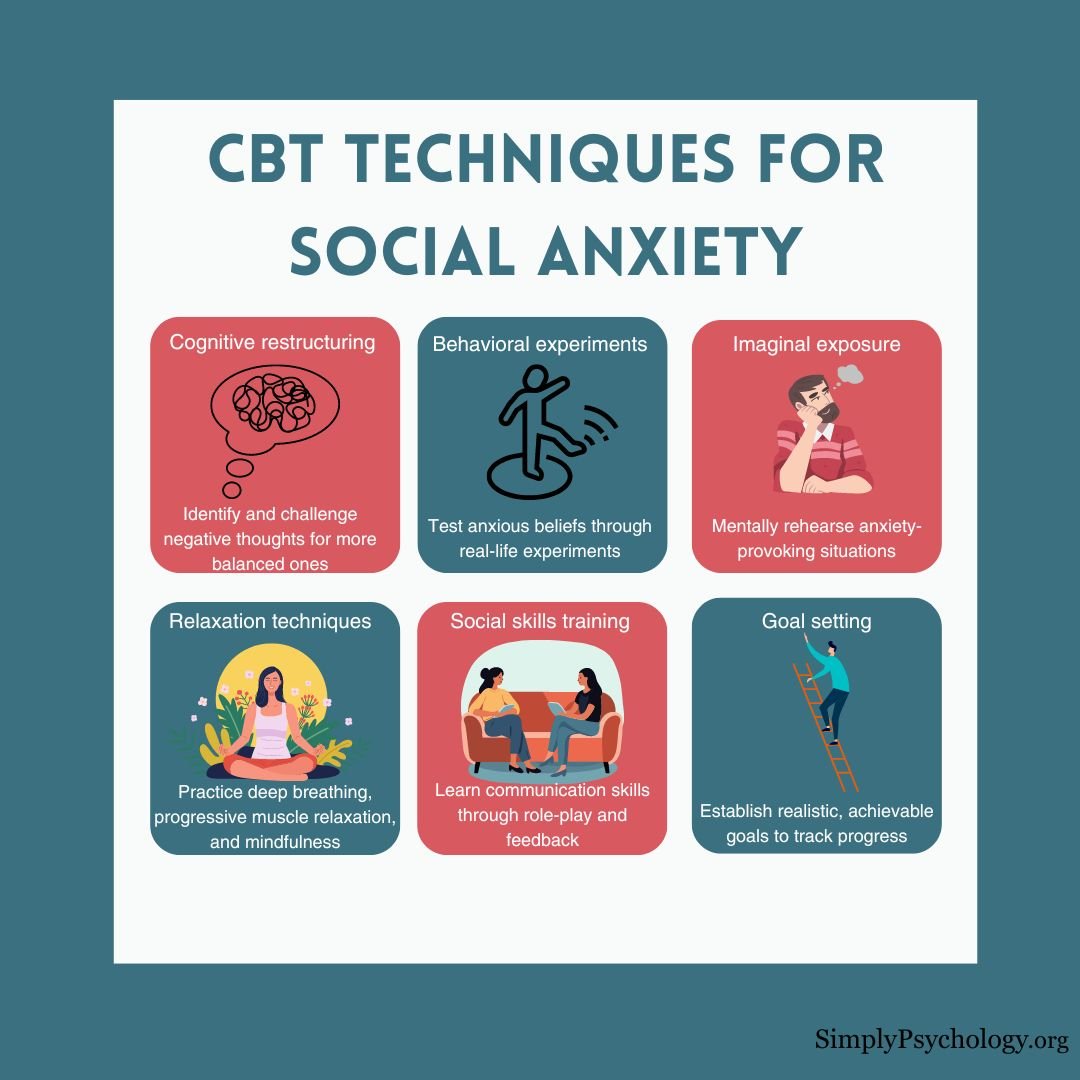
There are many techniques used in CBT, some of which will be discussed below:

Cognitive restructuring
Cognitive restructuring involves identifying and challenging negative thought patterns that contribute to social anxiety.
Often, people with social anxiety have distorted thoughts (also referred to as “hot thoughts”), like believing they will be humiliated or judged in social situations.
These often manifest as core beliefs, rooting themselves deep inside someone’s brain like alarm bells that go off when those hot thoughts occur.
In CBT, a therapist will help the individual recognize these irrational thoughts and replace them with more realistic and positive ones. This process involves examining the evidence for and against these thoughts and developing alternative, balanced perspectives.
For example, the thought:
“I will embarrass myself if I try to speak up during a meeting, and everyone will think I’m stupid” can be altered to
“While it may be possible that I might make a mistake, it is unlikely that everyone will think I am incompetent. Most people understand that mistakes happen. Therefore, if I prepare well, I can share my ideas confidently”.
Over time, cognitive restructuring can reduce the intensity of anxiety and help individuals approach social situations with greater confidence.Challenging Unhelpful Thoughts PDF
Behavioral experiments
Behavioral experiments are a key component of CBT for social anxiety. These experiments involve testing the accuracy of negative beliefs through real-life experiences.
For example, someone who fears public speaking might believe they will embarrass themselves and be judged harshly. A behavioral experiment could involve gradually exposing the individual to speaking in front of small, supportive groups and monitoring the outcomes.
Various sub-techniques can be used based on individual needs, end goals, and fear thresholds. These include the general go-to of “gradual exposure” and at the end of the spectrum a technique called “flooding” (presenting someone with their fear at its maximum capacity without allowing them to flee).
These experiments help people gather evidence that specifically challenges their negative beliefs and demonstrates that their fears are often unfounded. This process can reduce anxiety, build tolerance to it, and gradually increase confidence in social situations.
Imaginal Exposure
This method is particularly useful when real-life exposure is not feasible or when an individual is too anxious to confront the feared situation directly. It focuses on vividly imagining and mentally rehearsing situations that provoke anxiety.
Here is a step-by-step guide on how to practice this:
- Identify the Fear: Choose a specific situation that triggers social anxiety.
- Create a Script: Develop a detailed and vivid narrative of the feared situation, including thoughts, feelings, and sensory details.
- Relaxation: Before starting the exposure, engage in relaxation techniques such as deep breathing or progressive muscle relaxation to reduce baseline anxiety.
- Visualize the Scenario: Close your eyes and imagine the scenario in as much detail as possible. Try to engage all senses to make the visualization as realistic as possible.
- Stay with the Anxiety: Allow yourself to feel the anxiety without trying to avoid it. The goal is to experience the anxiety until it naturally decreases.
- Repeat and Review: Repeat the imaginal exposure regularly, gradually increasing the intensity of the scenario. After each session, review the experience and note any changes in anxiety levels.
Through using imaginal exposure you will begin to desensitize the feared scenario, reduce anxiety, and overall build confidence over time.
Behavioral Activation
This technique is based on the principle that engaging in positive activities can improve mood, reduce anxiety, and enhance overall well-being. It is used to help individuals engage in activities that are enjoyable or meaningful, which can counteract the tendency to withdraw and avoid situations due to social anxiety.
Here is an example scenario of behavioral activation to feeling isolated due to social anxiety. This has been broken down into steps for you to use and adapt:
- Identify Avoidance Behaviors: For example, avoiding social gatherings, rarely going out with friends, and spending most weekends alone at home.
- List Enjoyable or Meaningful Activities: For example, meeting a friend for coffee, attending a local book club, or taking a walk in the park.
- Set Specific Goals: For example, this week I will meet one friend for coffee, next week I will attend the book club meeting, and I will take a walk in the park twice this week.
- Plan Activities: For example, schedule coffee with a friend on Wednesday afternoon, mark the book club meeting on the calendar for next Thursday evening, and plan to take a walk in the park on Saturday and Sunday mornings.
- Gradual Exposure: Start with a less anxiety-provoking activity, like taking a walk in the park alone. Progress to meeting a friend for coffee, which involves social interaction but with a trusted person. Finally, attend the book club meeting, which involves interacting with a group of people.
- Monitor Progress: Keep a journal to record the activities completed, how they felt before, during, and after the activity, and any positive outcomes or challenges faced. Example entry: “Met Sarah for coffee on Wednesday. Felt anxious before going but enjoyed the conversation. Felt more relaxed and happy afterward.”
- Reward Success: Practice self-praise for example, “I did a great job meeting Sarah for coffee today. I felt anxious but went through with it and had a good time.”
Relaxation techniques
Relaxation techniques are used in CBT to help individuals manage the physical symptoms of anxiety. Techniques such as deep breathing, progressive muscle relaxation, grounding, and mindfulness meditation can reduce physiological arousal and promote a sense of calm.
Deep Breathing
To practice deep breathing, sit comfortably and inhale slowly through your nose for a count of four, letting your abdomen rise. Hold your breath for four counts, then exhale through your mouth for a count of six. Repeat this cycle for five to ten minutes to achieve a state of relaxation.
Progressive Muscle Relaxation
Start by sitting or lying down in a quiet place. Begin with your toes, tensing the muscles for five seconds, then relax for 15-20 seconds. Move up through the body, tensing and relaxing each muscle group to release overall tension.
Grounding
5-4-3-2-1 technique: identify five things you can see, four things you can touch, three things you can hear, two things you can smell, and one thing you can taste. This sensory awareness exercise helps divert attention from anxious thoughts and anchors you in the here and now.
Mindfulness
To practice mindfulness, sit comfortably in a quiet place and focus on your breath, noticing the sensation as it enters and leaves your nostrils.
When thoughts arise, acknowledge them without judgment and gently bring your focus back to your breath. Start with five to ten minutes daily to build this calming practice.
By practicing these techniques regularly, individuals can learn to control their anxiety responses in social situations.
Relaxation techniques can also work as a coping mechanism during exposure exercises, making it easier for individuals to confront and manage their fears.

Social skills training
Social skills training is an important aspect of CBT for social anxiety. Many people with social anxiety struggle with some basic social interactions and may lack confidence in their communication abilities.
Therefore, social skills training involves teaching specific skills, such as making eye contact, starting and maintaining conversations, and assertiveness. Exercises such as role-playing are often used to practice these skills in a safe and supportive environment.
Let us look at an example:
Jo experiences very strong anxiety when attending social gatherings. She often feels awkward and struggles to start conversations. Using SST, Jo’s therapist first helps her identify specific skills she wants to improve, such as starting conversations and maintaining eye contact.

Jo practices these skills through role-playing in various scenarios and receiving constructive feedback and positive reinforcement. She also learns assertiveness techniques, such as politely expressing her opinions and setting boundaries.

Over time, she becomes more confident in her social interactions, reducing her anxiety and enhancing her ability to connect with others.
This is an example of how social skills can help people enhance their social interactions and reduce anxiety over time.
Goal setting
Goal setting is a crucial part of the CBT process. Setting realistic and achievable goals can help individuals track their progress and stay motivated. Goals in CBT for social anxiety might include attending a social event, speaking up in a meeting, or initiating a conversation with a stranger.
Let us look at an example:
Ahmad experiences social anxiety in professional settings. His long-term goal is to feel comfortable and confident during work meetings. Therefore, his therapist began by helping him set SMART goals, starting with smaller, attainable steps.

Initially, Ahmad aims to contribute at least one comment or question during each meeting over the next month. He breaks this down into smaller steps, like preparing comments in advance, practicing speaking in front of a mirror, and role-playing with a friend.

They create an action plan together, detailing these steps and scheduling regular practice sessions. Ahmad tracks his progress, making notes on his experiences and any anxiety levels. With time and as he gains confidence, his goals are adjusted to include more challenging objectives, like leading parts of the meeting or presenting updates.
Therefore, by breaking down these goals into smaller, manageable steps, individuals can gradually build confidence and reduce their anxiety. Goal setting also provides a sense of accomplishment and reinforces the progress made in therapy!SMART Goals PDF
How effective is CBT for social anxiety?
CBT has been extensively researched and is widely recognized as one of the most effective treatments for social anxiety disorder.
Numerous studies have shown that CBT can significantly reduce symptoms of social anxiety and improve overall functioning, with long-term effects.
For example, a meta-analysis of randomized controlled trials found that CBT was more effective than placebo and other forms of therapy in reducing social anxiety symptoms.
The effectiveness of CBT is attributed to its structured and goal-oriented approach, which targets the specific thoughts and behaviors that contribute to anxiety.
By addressing these underlying issues, CBT helps individuals develop long-term strategies for managing their anxiety and improving their quality of life.
Additionally, CBT can be tailored to each individual’s needs, making it a versatile and adaptable treatment option.
Lastly, there is evidence to suggest that other forms of therapy can be equally as effective as CBT, such as psychodynamic therapy.
My Story
As someone who struggled with SAD for most of my life, CBT techniques have truly been transformative in my journey. For example, we made a list with the top 10 social phobias with a therapist (1 being the least frightening, 10 being the most), and we slowly started working down that list.
There were struggles in the beginning, such as overwhelming negative thoughts that I would never get better and feeling a loss of safety. SAD can exist to protect you from things your brain perceives as threats.
When you are actively trying to fight SAD tendencies, your body can react negatively at first as it feels it is in danger. Having a good support network and being open with your therapist is key to getting through this hurdle.
Once I started seeing results such as speaking on the phone without severely stuttering, I gained more confidence and began with flooding techniques such as signing up for seminars and conferences.
It was a long journey that took a few years to get me to the social functioning level that I am now. However, my life was forever changed for the better.
I have met so many incredible people and made happy memories that would have never happened had I stayed trapped in my head. I still get flare-ups from time to time, but slow and steady is key. So join me, and let us start living life, one small interaction at a time!
Considerations
While CBT is highly effective for many people with social anxiety, it may not work for everyone.
The success of CBT depends on various factors, including the individual’s commitment to the therapy process, the severity of their anxiety, and the quality of the therapeutic relationship.
As individuals confront their fears through exposure therapy, it is not uncommon for their symptoms to temporarily worsen before improving.
This initial increase in anxiety can be discouraging, and high dropout rates are possible, which can impact the overall effectiveness and progress of the therapy.
To combat this, additional support and reassurance from the therapist may be required. It is important to highlight that recovery and getting better is not linear, so it is completely normal to feel overwhelmed or out of your depth at times.
Additionally, CBT for social anxiety is not an overnight treatment but requires at minimum between 6-12 sessions. The standard course for SAD usually lies between the 12-20 session range.
There is flexibility in the delivery of SAD CBT as well which includes online and group sessions. These can benefit those with:
- Busy schedules
- Those whose SAD is too intense that prevents them from leaving the house to attend therapy
- Those who want to begin exploring social interactions in a structured, controlled group environment
Some individuals may benefit from a combination of CBT and medication or may require additional support to address other underlying issues. Therefore, it is important to work with a qualified mental health professional to determine the best treatment approach for your specific needs.
Lastly, it may not be applicable to a few people such as those with:
- Severe mental health issues, e.g., psychosis
- Personality disorders that will require a combination of therapeutic support
- Cognitive impairment struggles will make it challenging for them to engage in the sessions
- Those not ready or willing to engage in how active CBT is as it has components of homework and active participation outside of therapy
ReviewerAuthor
BSc (Hons) Psychology, MSc Psychology of Education
Associate Editor for Simply Psychology
Olivia Guy-Evans is a writer and associate editor for Simply Psychology, where she contributes accessible content on psychological topics. She is also an autistic PhD student at the University of Birmingham, researching autistic camouflaging in higher education.
BSc (Hons) Psychology, MRes, PhD, University of Manchester
Editor-in-Chief for Simply Psychology
Saul McLeod, PhD., is a qualified psychology teacher with over 18 years of experience in further and higher education. He has been published in peer-reviewed journals, including the Journal of Clinical Psychology.
认知行为疗法 (CBT) 如何帮助缓解社交焦虑?
CBT 通过使用认知重组和社交技能训练等技术,识别和调整导致社交场合焦虑的消极思维模式和行为,从而帮助缓解社交焦虑。因此,人们学习如何管理焦虑、建立信心并提高参与社交互动的能力。
社交焦虑症 ( SAD ),也称为社交恐惧症,其特征是由于担心被评判、尴尬和/或羞辱而经历强烈的恐惧和回避社交场合。
它的严重程度可能有所不同,从对特定情况的恐惧,如公开演讲,到对所有社交互动的更普遍的恐惧。这种恐惧会干扰日常活动、工作和人际关系,严重影响某人的生活。
认知行为疗法 ( CBT ) 是一种广泛使用的SAD 心理治疗方法,重点是识别和改变消极思维模式,以改变情绪反应和行为。
通过与训练有素的治疗师合作,人们可以学习应对策略来控制焦虑并改善社交互动。
在本文中,我们将探讨 CBT 如何帮助那些与社交焦虑作斗争的人,并重点介绍这种治疗方法中使用的一些关键技术。
为什么推荐 CBT 来治疗社交焦虑?
CBT被美国国家心理健康研究所(NIMH)、美国精神病学协会(APA)等多个机构强烈推荐用于治疗社交焦虑,因为它针对的是导致该疾病的根本原因,即消极的思维模式和回避行为。
研究一致表明,CBT 可以有效减轻社交焦虑症状并帮助个人发展更积极的社交互动。
CBT 的结构化性质,专注于特定目标和可衡量的结果,使其特别适合解决与社交焦虑相关的特定恐惧和行为。
具体来说,它可以支持:
- 识别和挑战消极想法:帮助个人识别和重构导致焦虑的无益想法。
- 逐渐接触令人恐惧的情况:鼓励个人以受控和渐进的方式面对社交情况。
- 制定应对策略:为个人配备实时管理焦虑的工具。
- 建立信心:通过技能建设练习增强自尊和自我效能。
- 提高社交技能:教授有效的沟通和社交互动技巧。
入门
通过 CBT 解决社交焦虑的关键一步是创建个性化的恐惧和回避层次结构。该工具可帮助您识别特定的焦虑触发因素并对其进行排名,为您的治疗之旅提供路线图。
如何创建你的层次结构:
- 列出您的恐惧:写下所有导致您焦虑的社交情况。内容要具体,范围广泛,从轻微不舒服到极其可怕。
- 评估您的恐惧程度:对于每种情况,从 0 到 100 的范围内评估您的恐惧程度,其中 0 表示没有恐惧,100 表示可以想象到的最强烈的恐惧。
- 对您的回避情况进行评分:类似地,对您避免每种情况的频率进行评分,评分范围为 0 到 100,其中 0 表示从不避免,100 表示始终避免。
- 对您的列表进行排名:根据您的恐惧等级,从最不引起焦虑到最引起焦虑的情况排列。
层次结构示例:
- 向邻居打招呼(恐惧:20,回避:10)
- 与收银员闲聊(恐惧:35,回避:30)
- 独自在公共场合吃饭(恐惧:50,回避:60)
- 在会议中提问(恐惧:70,回避:80)
- 在工作中进行演示(恐惧:90,回避:95)
使用你的层次结构:
- 从排名较低的项目开始,然后逐步提升。
- 将此作为设定暴露锻炼目标的指南。
- 通过定期重新评估您的恐惧和回避评级来跟踪您的进展。
创建这个层次结构可以让您可视化您的焦虑触发因素,并计划一个逐步的方法来面对您的恐惧。它是一个非常宝贵的工具,可用于设定现实的目标并衡量您在整个 CBT 旅程中的进度。曝光层次 PDF
治疗社交焦虑的 CBT 技术
CBT 中使用了许多技术,下面将讨论其中一些技术:
认知重建
认知重建涉及识别和挑战导致社交焦虑的消极思维模式。
通常,患有社交焦虑的人会有扭曲的想法(也称为“热门想法”),例如相信自己会在社交场合受到羞辱或评判。
这些往往表现为核心信念,深深扎根于某人的大脑中,就像警钟一样,当这些热门想法出现时就会响起。
在认知行为疗法中,治疗师将帮助个人认识到这些非理性的想法,并用更现实和积极的想法取代它们。这个过程包括检查支持和反对这些想法的证据,并发展替代的、平衡的观点。
例如,这样的想法:
“如果我在会议期间发言,我会感到尴尬,每个人都会认为我很愚蠢”可以改为
“虽然我可能会犯错误,但不太可能每个人都认为我无能。大多数人都明白错误是会发生的。因此,如果我准备充分,我可以自信地分享我的想法”。
随着时间的推移,认知重建可以减轻焦虑的强度,并帮助个人更有信心地应对社交场合。挑战无益的想法 PDF
行为实验
行为实验是社交焦虑认知行为疗法的关键组成部分。这些实验涉及通过现实生活的经历来测试消极信念的准确性。
例如,害怕公开演讲的人可能会认为他们会让自己难堪并受到严厉的评判。行为实验可能涉及逐渐让个人在支持性的小团体面前讲话并监测结果。
可以根据个人需求、最终目标和恐惧阈值使用各种子技术。其中包括常用的“逐渐暴露”,以及最后一种称为“洪水”的技术(以最大程度地向某人展示他们的恐惧,而不让他们逃跑)。
这些实验帮助人们收集证据,专门挑战他们的消极信念,并证明他们的恐惧往往是没有根据的。这个过程可以减少焦虑,建立对它的耐受性,并逐渐增强对社交场合的信心。
想象的曝光
当现实生活中的暴露不可行或当个人过于焦虑而无法直接面对恐惧的情况时,这种方法特别有用。它侧重于生动地想象和在心里演练引起焦虑的情况。
以下是有关如何练习的分步指南:
- 识别恐惧:选择引发社交焦虑的特定情况。
- 创建脚本:对令人恐惧的情况进行详细而生动的叙述,包括想法、感受和感官细节。
- 放松:在开始暴露之前,采用深呼吸或渐进式肌肉放松等放松技巧,以减少基线焦虑。
- 想象场景:闭上眼睛,尽可能详细地想象场景。尝试调动所有感官,使可视化尽可能真实。
- 与焦虑相处:让自己感受到焦虑,而不是试图避免它。目标是体验焦虑,直到它自然减少。
- 重复和回顾:定期重复想象的暴露,逐渐增加场景的强度。每次课程结束后,回顾体验并记录焦虑水平的任何变化。
通过使用想象的暴露,你将开始对恐惧的场景脱敏,减少焦虑,并随着时间的推移整体建立信心。
行为激活
该技术的原理是,参与积极的活动可以改善情绪、减少焦虑并增强整体幸福感。它用于帮助个人从事有趣或有意义的活动,这可以抵消由于社交焦虑而退缩和回避情况的倾向。
以下是由于社交焦虑而导致感到孤立的行为激活示例场景。这已分为几个步骤供您使用和适应:
- 识别回避行为:例如,避免社交聚会、很少与朋友外出以及大多数周末独自在家度过。
- 列出令人愉快或有意义的活动:例如,与朋友喝咖啡、参加当地的读书俱乐部或在公园散步。
- 设定具体目标:例如,本周我将与一位朋友喝咖啡,下周我将参加读书俱乐部会议,本周我将在公园散步两次。
- 计划活动:例如,安排周三下午与朋友喝咖啡,在日历上标记下周四晚上的读书俱乐部会议,并计划周六和周日早上在公园散步。
- 逐渐接触:从不太引起焦虑的活动开始,例如独自在公园散步。进展到与朋友喝咖啡,这涉及社交互动,但与值得信赖的人进行。最后,参加读书俱乐部会议,其中涉及与一群人互动。
- 监控进度:记日记,记录已完成的活动、活动之前、期间和之后的感受,以及任何积极的成果或面临的挑战。示例条目:“周三与莎拉一起喝咖啡。去之前感到焦虑,但很享受谈话。之后感觉更加放松和快乐。”
- 奖励成功:练习自我表扬,例如,“今天我和莎拉一起喝咖啡,做得很好。我感到焦虑,但还是克服了,玩得很开心。”
放松技巧
CBT 中使用放松技巧来帮助个人控制焦虑的身体症状。深呼吸、渐进式肌肉放松、接地和正念冥想等技巧可以减少生理唤醒并促进平静感。
深呼吸
要练习深呼吸,请舒适地坐着,通过鼻子慢慢吸气,数四下,让腹部上升。屏住呼吸数四下,然后用嘴呼气数六下。重复这个循环五到十分钟,以达到放松的状态。
渐进式肌肉放松
首先坐在或躺在一个安静的地方。从脚趾开始,绷紧肌肉 5 秒钟,然后放松 15-20 秒。向上移动身体,紧张和放松每个肌肉群以释放整体紧张。
接地
5-4-3-2-1技术:识别五种你可以看到的东西,四种你可以触摸的东西,三种你可以听到的东西,两种你可以闻到的东西,一种你可以尝到的东西。这种感官意识练习有助于将注意力从焦虑的想法上转移开来,让你专注于此时此地。
正念
要练习正念,请舒适地坐在安静的地方,专注于呼吸,注意呼吸进入和离开鼻孔时的感觉。
当想法出现时,不加评判地承认它们,并轻轻地将注意力带回到呼吸上。从每天五到十分钟开始进行这种平静的练习。
通过定期练习这些技巧,个人可以学会在社交场合控制自己的焦虑反应。
放松技巧也可以作为暴露练习期间的应对机制,使个人更容易面对和管理他们的恐惧。
社交技能训练
社交技能训练是CBT治疗社交焦虑的一个重要方面。许多患有社交焦虑症的人在一些基本的社交互动中遇到困难,并且可能对自己的沟通能力缺乏信心。
因此,社交技能培训涉及教授特定技能,例如眼神交流、开始和维持对话以及自信。角色扮演等练习通常用于在安全和支持性的环境中练习这些技能。
让我们看一个例子:
乔在参加社交聚会时感到非常强烈的焦虑。她经常感到尴尬并且难以开始对话。使用 SST,Jo 的治疗师首先帮助她确定想要提高的具体技能,例如开始对话和保持眼神交流。

乔通过在各种场景中进行角色扮演并接受建设性反馈和积极强化来练习这些技能。她还学习自信技巧,例如礼貌地表达自己的意见和设定界限。

随着时间的推移,她对自己的社交互动变得更加自信,减少了焦虑并增强了与他人联系的能力。
这是社交技能如何帮助人们增强社交互动并随着时间的推移减少焦虑的一个例子。
目标设定
目标设定是 CBT 过程的关键部分。设定现实且可实现的目标可以帮助个人跟踪自己的进展并保持动力。 CBT 治疗社交焦虑的目标可能包括参加社交活动、在会议上发言或与陌生人开始对话。
让我们看一个例子:
艾哈迈德在职业环境中经历社交焦虑。他的长期目标是在工作会议期间感到舒适和自信。因此,他的治疗师首先帮助他设定 SMART 目标,从较小的、可实现的步骤开始。

最初,艾哈迈德的目标是在下个月的每次会议上至少提出一条评论或问题。他将其分解为更小的步骤,例如提前准备评论、在镜子前练习说话以及与朋友进行角色扮演。

他们一起制定行动计划,详细说明这些步骤并安排定期练习。艾哈迈德跟踪他的进展,记录他的经历和任何焦虑程度。随着时间的推移,随着他信心的增强,他的目标会进行调整,以包括更具挑战性的目标,例如主持会议或介绍最新情况。
因此,通过将这些目标分解为更小的、可管理的步骤,个人可以逐渐建立信心并减少焦虑。目标设定还可以提供成就感并强化治疗取得的进展!智能目标 PDF
CBT 对社交焦虑有多有效?
CBT 已被广泛研究并被广泛认为是社交焦虑症最有效的治疗方法之一。
大量研究表明,CBT 可以显着减轻社交焦虑症状并改善整体功能,并具有长期效果。
例如,一项随机对照试验的荟萃分析发现,CBT 在减少社交焦虑症状方面比安慰剂和其他形式的治疗更有效。
CBT 的有效性归因于其结构化和目标导向的方法,该方法针对导致焦虑的特定思想和行为。
通过解决这些根本问题,认知行为疗法可以帮助个人制定长期策略来管理焦虑和改善生活质量。
此外,CBT 可以根据每个人的需求进行定制,使其成为一种多功能且适应性强的治疗选择。
最后,有证据表明其他形式的治疗可以与 CBT 同等有效,例如心理动力学治疗。
我的故事
作为一个一生中大部分时间都在与悲伤情绪作斗争的人,CBT 技术确实给我的旅程带来了变革。例如,我们与治疗师一起列出了十大社交恐惧症列表(1 是最不可怕的,10 是最可怕的),然后我们慢慢地开始研究这个列表。
一开始我有些挣扎,比如压倒性的消极想法,认为我永远不会好起来,感觉失去安全感。 SAD 的存在可以保护您免受大脑视为威胁的事物的侵害。
当您积极尝试对抗悲伤倾向时,您的身体一开始可能会做出负面反应,因为它感觉自己处于危险之中。拥有良好的支持网络并与治疗师保持开放的态度是克服这一障碍的关键。
一旦我开始看到诸如打电话时没有严重口吃等结果,我就获得了更多信心,并开始采用洪流技术,例如报名参加研讨会和会议。
这是一个漫长的旅程,花了几年时间才让我达到现在的社会功能水平。然而,我的生活永远变得更好了。
我遇到了很多令人难以置信的人,并留下了快乐的回忆,如果我一直困在脑海里,这些回忆就永远不会发生。我仍然时不时地突然爆发,但缓慢而稳定是关键。所以加入我,让我们开始生活,一次一小段互动!
注意事项
虽然 CBT 对许多患有社交焦虑症的人非常有效,但它可能并不适合所有人。
CBT 的成功取决于多种因素,包括个人对治疗过程的承诺、焦虑的严重程度以及治疗关系的质量。
当人们通过暴露疗法面对恐惧时,他们的症状在改善之前暂时恶化的情况并不少见。
焦虑的最初增加可能令人沮丧,并且可能会出现高退出率,这可能会影响治疗的整体效果和进展。
为了解决这个问题,可能需要治疗师的额外支持和保证。需要强调的是,恢复和变得更好并不是线性的,因此有时感到不知所措或超出自己的深度是完全正常的。
此外,针对社交焦虑的 CBT 不是一夜之间的治疗方法,而是至少需要 6 至 12 次疗程。 SAD 的标准课程通常在 12-20 节课之间。
SAD CBT 的提供也很灵活,包括在线和小组会议。这些可以使那些具有以下特征的人受益:
- 日程繁忙
- 那些因悲伤情绪太严重而无法出门接受治疗的人
- 那些想要在结构化、受控的群体环境中开始探索社交互动的人
有些人可能会受益于 CBT 和药物治疗的结合,或者可能需要额外的支持来解决其他潜在问题。因此,与合格的心理健康专家合作以确定适合您特定需求的最佳治疗方法非常重要。
最后,它可能不适用于少数人,例如:
- 严重的心理健康问题,例如精神病
- 需要综合治疗支持的人格障碍
- 认知障碍的困扰将使他们难以参与课程
- 那些还没有准备好或不愿意参与 CBT 的积极程度的人,因为它包含家庭作业和治疗之外的积极参与
审稿人作者
心理学(荣誉)理学学士、教育心理学理学硕士
《简单心理学》副主编
奥利维亚·盖伊-埃文斯 (Olivia Guy-Evans) 是《Simply Psychology》的作家兼副编辑,她在其中提供有关心理学主题的易懂内容。她也是伯明翰大学的一名自闭症博士生,研究高等教育中的自闭症伪装。
曼彻斯特大学心理学学士(荣誉)、研究硕士、博士
《简单心理学》主编
Saul McLeod 博士是一位合格的心理学教师,在继续教育和高等教育方面拥有超过 18 年的经验。他曾在同行评审期刊上发表文章,包括《临床心理学杂志》。