

背外侧前额叶皮层
As a psychology student, understanding the dorsolateral prefrontal cortex (DLPFC) is important because it’s central to many of the core topics you’ll study: attention, memory, decision-making, self-control, and mental health.
When you learn about executive functions, you’re really studying the capacities that the DLPFC helps support.
In experiments using tasks like the Stroop test, the Wisconsin Card Sorting Test, or working memory tasks (e.g. n-back), the DLPFC is active and often a focus of measurement, because changes in its functioning tell us how people think, adapt, and learn.
It also comes up in clinical psychology: many disorders (e.g. depression, ADHD, schizophrenia) involve differences in DLPFC function.
Knowing how the DLPFC is studied, what goes wrong, and how it can be strengthened or compensated for gives you a bridge between theory and application.

Location and Structure
The dorsolateral prefrontal cortex (DLPFC) is a part of the frontal lobe of the brain. It sits toward the top and side (dorsolateral = dorsal + lateral) of the prefrontal cortex.
You can find it on the middle frontal gyrus, which is one of the ridges on the brain’s surface in the frontal lobe.
In terms of Brodmann areas (a system dividing the cortex into numbered regions based on how the cells are organized), the DLPFC mainly covers Brodmann Area 9 and Area 46.
Area 9 is more toward the top (dorsal) side of the frontal lobe, and Area 46 is slightly more toward the middle (lateral) side, but both are very close and often work together.
The DLPFC is connected to many other brain regions: sensory areas (for input), memory-related areas like the hippocampus, and subcortical structures like parts of the thalamus and basal ganglia.
This network of connections lets the DLPFC integrate incoming information, keep things in mind, plan actions, and control behaviour.
Laterality matters: for example, verbal tasks (language work) tend to activate more of the left DLPFC, while spatial and visual tasks often use more of the right DLPFC.
Functions of the DLPFC
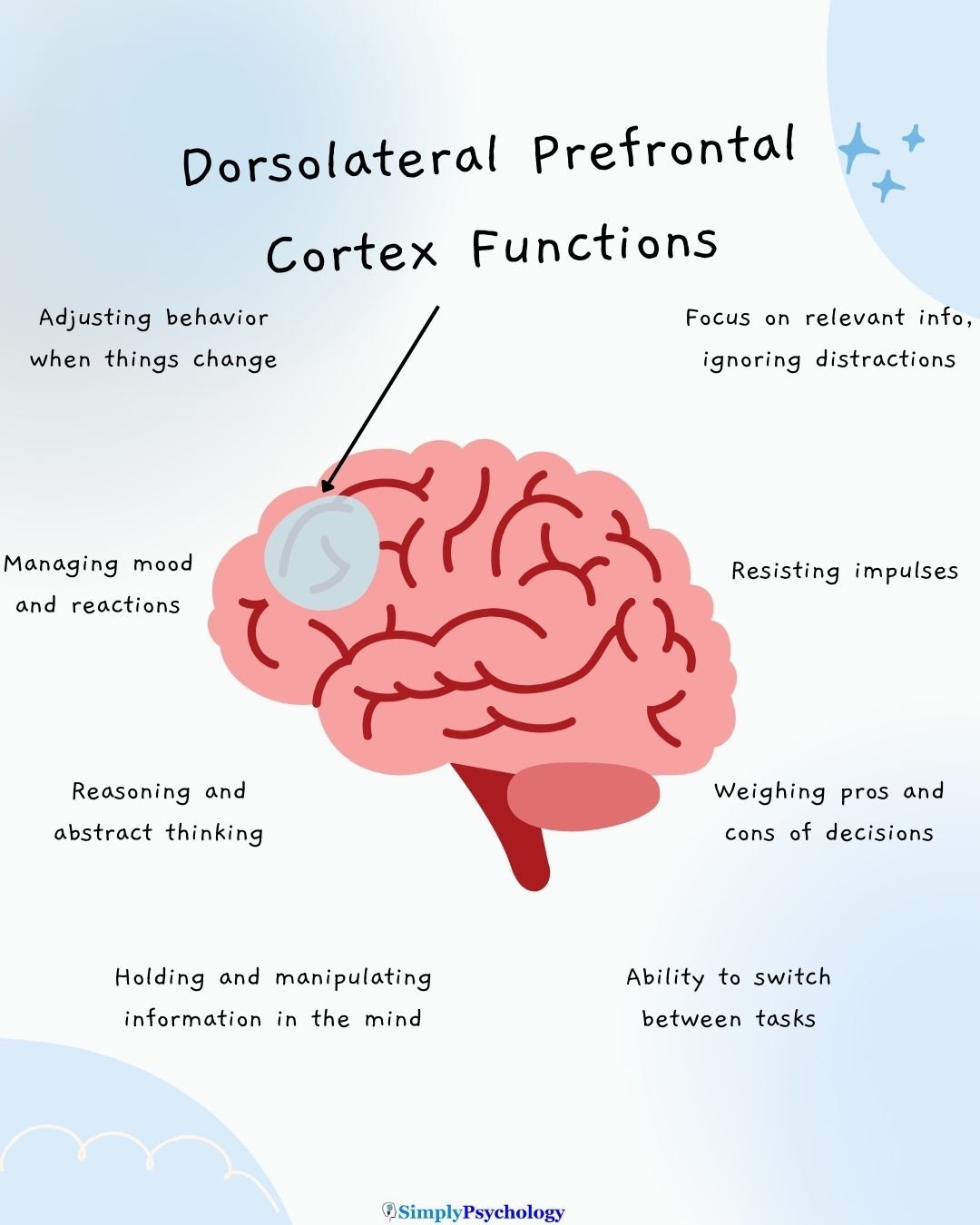
The dorsolateral prefrontal cortex (DLPFC) is one of the brain’s key regions for executive functions and higher-order cognition.
That means it helps with thinking tasks where you have to plan, hold information in mind, make decisions, and control your behaviour.
Working Memory and Attention
Working memory is like a mental scratchpad: the ability to hold and work with information in your mind for short periods.
The DLPFC is especially important for manipulating information—not just remembering it, but rearranging it, comparing items, or updating what’s relevant.
For example, if you remember numbers and then have to sort them in your head, the DLPFC helps with that.
Attention is also guided by the DLPFC. It helps you focus on what’s important and ignore irrelevant distractions.
It also helps you shift your focus when needed — perhaps from listening in class to taking notes, then back again. This ability to flexibly shift and maintain attention is essential to learning and problem-solving.
Decision-making and Problem-solving
The DLPFC contributes to decision-making by helping you evaluate different options and think about consequences.
When you weigh pros and cons, predict what might happen, or choose between short-term reward vs long-term benefit, the DLPFC is active.
Problem-solving often involves planning steps, dealing with unexpected obstacles, and adjusting strategies.
The DLPFC supports flexible thinking — meaning if your first idea doesn’t work, you can switch to a new approach. It also helps when you have to stay goal-oriented, keeping in mind what you want to achieve and resisting distractions.
Emotional Regulation and Self-Control
Emotional regulation means being able to manage your feelings so that they’re appropriate for the situation.
The DLPFC plays a big part here by helping suppress or adjust emotional reactions when necessary (for example, cooling down anger, or resisting impulses).
It helps you think before acting, rather than acting purely out of emotion.
Self-control is closely related: it’s the ability to resist temptations, delay gratification (choosing a bigger reward later rather than a smaller one now), or ignore impulses.
Studies show that greater activity in the DLPFC is associated with better self-control in tasks (e.g., resisting unhealthy food choices) and that disrupting DLPFC activity makes self-control harder.
Development and Plasticity of the DLPFC
The DLPFC isn’t fully mature at birth – in fact, it keeps developing through adolescence and into early adulthood.
During the teen years, the structure of the DLPFC changes: the thickness of its cortex tends to thin over time, which is thought to be a sign of pruning away unused neural connections and making the remaining ones more efficient.
Also, white matter (nerve fibres that help different brain areas communicate) increases in the prefrontal cortex during this period, helping signals travel faster.
These physical changes coincide with improvements in executive functions: adolescents become better at planning, focusing attention, resisting impulsive responses, and switching tasks.
As the DLPFC matures, these high-level thinking skills become more reliable and flexible.
Neuroplasticity means the brain can change with experience, and the DLPFC is plastic. Learning new high-demand cognitive tasks (like working memory training) can increase activity in the DLPFC, recruit more neurons, or alter how neurons fire in response to a task.
Also, therapies, education, or structured training can strengthen connections or improve control over behaviour and emotion via the DLPFC.
Clinical Relevance of the DLPFC
When it is impaired or underactive, many psychological disorders show deficits in these areas. Problems can include difficulty keeping thoughts in mind, poor planning, trouble shifting attention, and weak self-control.
These impairments can seriously affect a person’s daily functioning — school, work, social life.
Below are some specific disorders where DLPFC dysfunction plays a role.
Depression and Mood Disorders
In major depressive disorder (MDD), studies often find that the left DLPFC is underactive. This underactivity is linked with symptoms like negative thinking, low motivation, and difficulty initiating behaviour.
When treatments like transcranial magnetic stimulation (TMS) successfully increase DLPFC activity, people’s depression symptoms often reduce.
This suggests that part of depression’s cognitive symptoms may come from a failure in the DLPFC’s ability to regulate mood and control negative thought patterns.
ADHD and Executive Dysfunction
Attention-Deficit Hyperactivity Disorder (ADHD) is another disorder where the DLPFC often shows reduced function.
People with ADHD may struggle with working memory deficits, which means they find it harder to hold information in mind and use it.
They may also have difficulty with impulse control and resisting distractions. Brain imaging studies show that networks involving the DLPFC are less active or less well-connected in ADHD compared to neurotypical individuals.
These impairments help explain symptoms like forgetfulness, interrupting others, and trouble finishing tasks, which are common in ADHD.
Schizophrenia and Other Conditions
In schizophrenia, DLPFC dysfunction is associated with more severe cognitive deficits, such as problems with memory, planning, and organizing thoughts.
The DLPFC tends to show reduced activity or abnormal connectivity with other brain regions like the cerebellum.
These changes are linked with disorganized thinking, difficulties in following conversations or tasks, and sometimes psychosis (hallucinations or delusions).
References
Asgharian Asl, F., Abbaszade, S., Derakhshani, H., Vaghef, L., & Asgharian Asl, A. (2024). Unilateral vs. Bilateral DLPFC rTMS: Comparative effects on depression, visual-spatial memory, inhibitory control and cognitive flexibility in major depressive disorder. Frontiers in Psychiatry, 15, 1400414. https://doi.org/10.3389/fpsyt.2024.1400414
Benschop, L., Vanhollebeke, G., Li, J., Leahy, R. M., Vanderhasselt, M., & Baeken, C. (2022). Reduced subgenual cingulate–dorsolateral prefrontal connectivity as an electrophysiological marker for depression. Scientific Reports, 12(1), 1-11. https://doi.org/10.1038/s41598-022-20274-9
Kumari, V., Peters, E. R., Fannon, D., Antonova, E., Premkumar, P., Anilkumar, A. P., Williams, S. C., & Kuipers, E. (2009). Dorsolateral Prefrontal Cortex Activity Predicts Responsiveness to Cognitive–Behavioral Therapy in Schizophrenia. Biological Psychiatry, 66(6), 594. https://doi.org/10.1016/j.biopsych.2009.04.036
Smucny, J., Dienel, S. J., Lewis, D. A., & Carter, C. S. (2021). Mechanisms underlying dorsolateral prefrontal cortex contributions to cognitive dysfunction in schizophrenia. Neuropsychopharmacology, 47(1), 292. https://doi.org/10.1038/s41386-021-01089-0
ReviewerAuthor
BSc (Hons) Psychology, MRes, PhD, University of Manchester
Editor-in-Chief for Simply Psychology
Saul McLeod, PhD., is a qualified psychology teacher with over 18 years of experience in further and higher education. He has been published in peer-reviewed journals, including the Journal of Clinical Psychology.
背外侧前额皮质
作为一名心理学学生,了解背外侧前额叶皮层(DLPFC) 非常重要,因为它是您将学习的许多核心主题的核心:注意力、记忆力、决策、自我控制和心理健康。
当您了解执行功能时,您实际上是在研究 DLPFC 帮助支持的能力。
在使用斯特鲁普测试、威斯康星卡片分类测试或工作记忆任务(例如 n-back)等任务的实验中,DLPFC 很活跃,并且通常是测量的焦点,因为其功能的变化告诉我们人们如何思考、适应和学习。
它也出现在临床心理学中:许多疾病(例如抑郁症、注意力缺陷多动症、精神分裂症)都与 DLPFC 功能的差异有关。
了解 DLPFC 是如何研究的、出了什么问题以及如何加强或补偿它,可以为您在理论和应用之间架起一座桥梁。
位置和结构
背外侧前额叶皮层(DLPFC)是大脑额叶的一部分。它位于前额皮质的顶部和侧面(背外侧=背侧+外侧)。
您可以在额中回找到它,它是额叶大脑表面的脊之一。
就布罗德曼区(根据细胞组织方式将皮质划分为编号区域的系统)而言,DLPFC 主要涵盖布罗德曼区 9 和区 46。
区域 9 更靠近额叶的顶部(背侧),而区域 46 则稍微靠近中间(侧面)侧,但两者非常接近并且经常一起工作。
DLPFC 与许多其他大脑区域相连:感觉区域(用于输入)、与记忆相关的区域(如海马体)以及皮层下结构(如丘脑和基底神经节的部分)。
这种连接网络让 DLPFC 能够整合传入的信息、记住事情、计划行动并控制行为。
偏侧性很重要:例如,言语任务(语言工作)倾向于激活更多的左侧DLPFC,而空间和视觉任务通常更多地使用右侧DLPFC。
DLPFC 的功能
背外侧前额叶皮层(DLPFC)是大脑执行功能和高阶认知的关键区域之一。
这意味着它有助于完成思考任务,在这些任务中,你必须计划、牢记信息、做出决定和控制自己的行为。
工作记忆和注意力
工作记忆就像一个心理便签本:能够在头脑中短时间保存和处理信息。
DLPFC 对于处理信息尤其重要——不仅仅是记住信息,还包括重新排列信息、比较项目或更新相关内容。
例如,如果你记住了数字,然后必须在头脑中对它们进行排序,DLPFC 会帮助你做到这一点。
注意力也由 DLPFC 引导。它可以帮助您专注于重要的事情并忽略不相关的干扰。
它还可以帮助您在需要时转移注意力——也许从课堂上听讲到记笔记,然后再返回。这种灵活转移和保持注意力的能力对于学习和解决问题至关重要。
决策和解决问题
DLPFC 通过帮助您评估不同的选择并考虑后果来为决策做出贡献。
当您权衡利弊、预测可能发生的情况或在短期回报与长期利益之间进行选择时, DLPFC 就会处于活跃状态。
解决问题通常涉及规划步骤、处理意外障碍和调整策略。
DLPFC 支持灵活的思维——这意味着如果您的第一个想法行不通,您可以转向新的方法。当您必须保持目标导向、牢记自己想要实现的目标并抵制干扰时,它也会有所帮助。
情绪调节和自我控制
情绪调节意味着能够管理您的感受,使其适合当前情况。
DLPFC 在这里发挥着重要作用,在必要时帮助抑制或调整情绪反应(例如,平息愤怒或抵制冲动)。
它可以帮助你在行动之前思考,而不是纯粹出于情感而行动。
自我控制是密切相关的:它是抵制诱惑、延迟满足(稍后选择更大的奖励而不是现在选择更小的奖励)或忽略冲动的能力。
研究表明,DLPFC 的活动越大,任务中的自我控制能力越高(例如,抵制不健康的食物选择),而破坏 DLPFC 的活动会使自我控制变得更加困难。
DLPFC的发育和可塑性
DLPFC 在出生时并未完全成熟,事实上,它在青春期和成年早期不断发育。
在青少年时期,DLPFC 的结构发生变化:随着时间的推移,其皮质的厚度趋于变薄,这被认为是修剪掉未使用的神经连接并使剩余神经连接更加有效的标志。
此外,在此期间,前额叶皮层的白质(帮助不同大脑区域沟通的神经纤维)增加,有助于信号更快地传播。
这些身体变化与执行功能的改善相一致:青少年变得更擅长计划、集中注意力、抵制冲动反应和切换任务。
随着 DLPFC 的成熟,这些高级思维技能变得更加可靠和灵活。
神经可塑性意味着大脑可以随着经验而改变,而 DLPFC 是可塑的。学习新的高要求认知任务(如工作记忆训练)可以增加 DLPFC 的活动,招募更多神经元,或改变神经元响应任务的方式。
此外,治疗、教育或结构化训练可以通过 DLPFC 加强联系或改善对行为和情绪的控制。
DLPFC 的临床相关性
当它受损或不活跃时,许多心理障碍都会在这些方面表现出缺陷。问题可能包括难以记住想法、计划不周、难以转移注意力以及自我控制能力薄弱。
这些障碍会严重影响一个人的日常功能——学校、工作、社交生活。
以下是 DLPFC 功能障碍所导致的一些特定疾病。
抑郁症和情绪障碍
对于重度抑郁症 (MDD),研究经常发现左侧DLPFC活动不足。这种活动不足与消极思维、低积极性和难以发起行为等症状有关。
当经颅磁刺激 ( TMS )等治疗成功增加 DLPFC 活性时,人们的抑郁症状通常会减轻。
这表明抑郁症的部分认知症状可能来自 DLPFC 调节情绪和控制消极思维模式的能力失败。
多动症和执行功能障碍
注意力缺陷多动障碍 ( ADHD ) 是另一种 DLPFC 经常表现出功能下降的疾病。
患有多动症的人可能会面临工作记忆缺陷的困扰,这意味着他们很难记住并使用信息。
他们也可能难以控制冲动和抵制干扰。脑成像研究表明,与神经正常个体相比,ADHD 患者的 DLPFC 网络不太活跃或连接较差。
这些障碍有助于解释多动症中常见的健忘、打扰他人和难以完成任务等症状。
精神分裂症和其他病症
在精神分裂症中, DLPFC 功能障碍与更严重的认知缺陷相关,例如记忆、计划和组织思维问题。
DLPFC往往表现出活动减少或与小脑等其他大脑区域的连接异常。
这些变化与思维混乱、对话或任务困难以及有时精神错乱(幻觉或妄想)有关。
参考
Asgharian Asl, F.、Abbaszade, S.、Derakhshani, H.、Vaghef, L. 和 Asgharian Asl, A. (2024)。单侧与双侧 DLPFC rTMS:对重度抑郁症的抑郁、视觉空间记忆、抑制控制和认知灵活性的影响比较。精神病学前沿,15,1400414。https : //doi.org/10.3389/fpsyt.2024.1400414
Benschop, L.、Vanhollebeke, G.、Li, J.、Leahy, RM、Vanderhasselt, M. 和 Baeken, C. (2022)。膝下扣带回-背外侧前额叶连接减少作为抑郁症的电生理标志。科学报告,12 (1),1-11。https://doi.org/10.1038/s41598-022-20274-9
Kumari, V.、Peters, ER、Fannon, D.、Antonova, E.、Premkumar, P.、Anilkumar, AP、Williams, SC 和 Kuipers, E. (2009)。背外侧前额叶皮层活动预测精神分裂症认知行为治疗的反应。生物精神病学,66(6),594。https ://doi.org/10.1016/j.biopsych.2009.04.036
Smucny, J.、Dienel, SJ、Lewis, DA 和 Carter, CS (2021)。背外侧前额叶皮层对精神分裂症认知功能障碍的潜在机制。神经精神药理学,47(1),292。https://doi.org/10.1038/s41386-021-01089-0
审稿人作者
曼彻斯特大学心理学学士(荣誉)、研究硕士、博士
《简单心理学》主编
Saul McLeod 博士是一位合格的心理学教师,在继续教育和高等教育方面拥有超过 18 年的经验。他曾在同行评审期刊上发表文章,包括《临床心理学杂志》。