

背内侧前额叶皮层
The dorsomedial prefrontal cortex (dmPFC) is a key region of the brain’s frontal lobe that plays a central role in higher-order cognition. It is consistently active when we reflect on ourselves, consider other people’s thoughts and feelings, and make complex decisions.
Because it connects both with emotion-related areas and networks that support abstract reasoning, the dmPFC serves as a bridge between how we think, feel, and interact socially.
Breaking Down the Term
- Dorso = top
- Medial = middle/inner surface
- Prefrontal = front of the frontal lobe (just behind the forehead)
- Cortex = outer layer of the brain, involved in advanced mental processes
Together, “dorsomedial prefrontal cortex” simply means the top-middle part of the prefrontal cortex.
Key Takeaways
- Cognitive hub – The dmPFC links thinking, emotion, and social processes in higher-order cognition.
- Self & others – It supports self-reflection, perspective-taking, and theory of mind.
- Emotion control – Connections with the amygdala help regulate fear and anxiety.
- Mental health – Dysfunction is linked to depression, anxiety, PTSD, autism, and schizophrenia.
- Practical importance – Insights guide therapy, brain stimulation, and studies of self and consciousness.
Anatomy and Location of the dmPFC
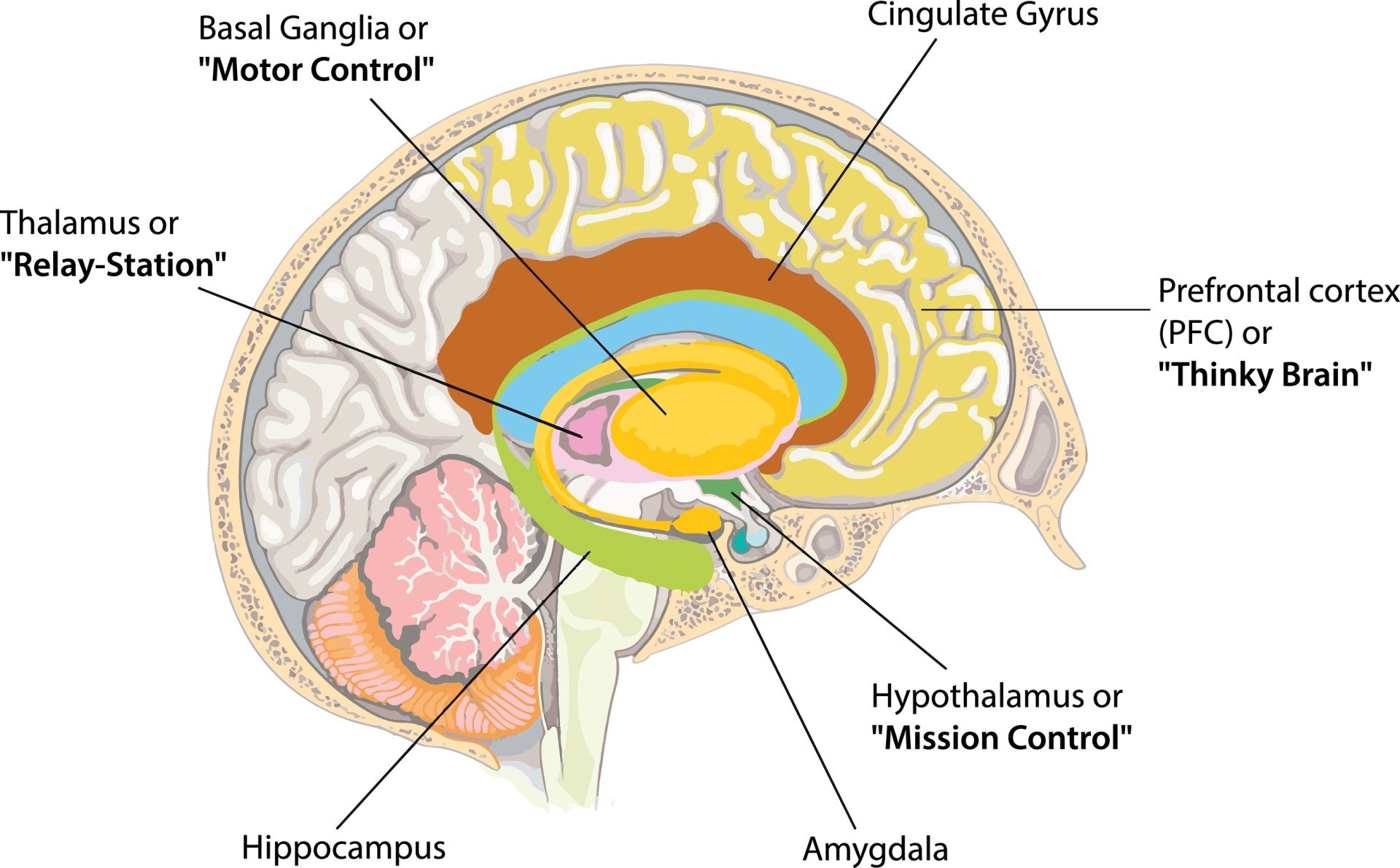
The dorsomedial prefrontal cortex (dmPFC) is part of the medial prefrontal cortex, located on the inner surface of the frontal lobes.
The Dorsomedial (dmPFC) is the “middle” or inner portion of the top frontal lobe, located on the medial (inner) surface of the frontal lobes, where the two hemispheres face each other.
It spans regions of Brodmann areas 8, 9, 10, and sometimes parts of 24 and 32.
These subregions overlap with the dorsal anterior cingulate cortex and are situated just above the ventromedial prefrontal cortex (vmPFC).
Neural connections
The dmPFC has widespread connections with limbic regions, including the amygdala and hippocampus, allowing it to influence emotional responses and memory.
It also communicates with the thalamus and other prefrontal regions, supporting cognitive control and flexible behavior.
Importantly, the dmPFC is a key node in the default mode network (DMN)—a set of regions active during rest and self-referential thought.
Through its interactions with the posterior cingulate cortex, precuneus, and angular gyrus, the dmPFC supports processes like self-awareness, perspective-taking, and social cognition.
Core Functions of the dmPFC
The dorsomedial prefrontal cortex (dmPFC) supports several forms of higher-order cognition. It is strongly engaged during tasks that involve self-awareness, social reasoning, and evaluating complex choices.
Rather than handling one single function, the dmPFC acts as a flexible hub, linking together emotional, cognitive, and social processes.
Self-reflection and introspection
The dmPFC is central to thinking about the self.
Neuroimaging studies show greater activation when people reflect on their own traits, emotions, or memories compared to thinking about neutral information.
This activity supports self-awareness and helps maintain a continuous sense of identity across time.
By integrating personal information with broader social knowledge, the dmPFC allows us to evaluate our own mental and emotional states.
Decision-making and conflict processing
The dmPFC also contributes to decision-making, particularly when choices involve uncertainty or internal conflict.
It helps us weigh competing options and adjust when instinctive reactions clash with external demands or long-term goals.
For example, it is active when individuals must choose between equally appealing alternatives or when evaluating short-term versus long-term rewards.
In this way, the dmPFC plays a role in assigning value to different choices in both personal and social contexts.
Cognitive control
A further role of the dmPFC is in cognitive control—balancing rational thought with emotional impulses. It helps regulate impulsivity, reduce egocentric bias, and predict possible outcomes in ambiguous situations.
Studies suggest that increasing activity in this region can improve self-control and promote more deliberate decision-making.
This makes the dmPFC important for adapting flexibly to complex or changing environments.
Role in Social Cognition
The dorsomedial prefrontal cortex (dmPFC) plays a central role in social cognition—our ability to understand and interact with others in sophisticated ways.
It’s particularly important for theory of mind, helping us recognize that other people have beliefs, intentions, and perspectives different from our own.
The dmPFC integrates multiple sources of social information for making judgments about others.
Empathy and Moral Reasoning
The dmPFC contributes substantially to empathy and moral evaluation.
It becomes more active when we consider how others feel or when we make moral judgments that require understanding others’ intentions.
The region also plays a role in forming ethical judgments, especially when integrating information about others’ motives.
Social Evaluation
The dmPFC is sensitive to social feedback and our sense of belonging. Its activity also increases when anticipating approval, highlighting its involvement in both positive and negative social evaluation.
Role in Emotion Regulation and Mental Health
The dorsomedial prefrontal cortex (dmPFC) supports emotion regulation—the processes that help us manage feelings like fear or anxiety.
It helps to dampen intense emotional reactions by influencing limbic areas like the amygdala.
This top-down regulation is essential for staying calm during stressful or threatening situations.
Depression and Anxiety Disorders
In mood and anxiety disorders such as major depressive disorder (MDD) and generalized anxiety disorder (GAD), the dmPFC often shows reduced engagement during tasks requiring emotion regulation (especially cognitive reappraisal).
That means individuals may struggle to reframe or manage negative thoughts effectively. Research suggests that those with depression also tend to have reduced gray matter volume in the dmPFC.
PTSD and Trauma
In post-traumatic stress disorder (PTSD), the dmPFC (and other medial prefrontal areas) shows lower activation in response to emotional stimuli.
This underactivity weakens its ability to regulate fear circuits—especially the amygdala—resulting in persistent, intrusive distress and heightened reactivity.
Autism and Schizophrenia
While direct studies of dmPFC in these conditions are fewer, some findings suggest it may be less activated or differently engaged in both autism and schizophrenia.
In autism, this may contribute to challenges with social-emotional processing and self-referential thinking.
Individuals with schizophrenia may experience similar disruptions, affecting cognitive control and emotion regulation.
References
Bora, E., Fornito, A., Pantelis, C., & Yücel, M. (2012). Gray matter abnormalities in Major Depressive Disorder: A meta-analysis of voxel based morphometry studies. Journal of Affective Disorders, 138(1-2), 9-18. https://doi.org/10.1016/j.jad.2011.03.049
Keller, M., Mendoza-Quiñones, R., Cabrera Muñoz, A., Iglesias-Fuster, J., Virués, A. V., Zvyagintsev, M., … & Mathiak, K. (2022). Transdiagnostic alterations in neural emotion regulation circuits–neural substrates of cognitive reappraisal in patients with depression and post-traumatic stress disorder. Bmc Psychiatry, 22(1), 173.ReviewerAuthor
BSc (Hons) Psychology, MRes, PhD, University of Manchester
Editor-in-Chief for Simply Psychology
Saul McLeod, PhD., is a qualified psychology teacher with over 18 years of experience in further and higher education. He has been published in peer-reviewed journals, including the Journal of Clinical Psychology.
背内侧前额叶皮层
背内侧前额皮质( dmPFC )是大脑额叶的关键区域,在高阶认知中发挥着核心作用。当我们反思自己、考虑他人的想法和感受并做出复杂的决定时,它始终处于活跃状态。
由于 dmPFC 与情感相关区域和支持抽象推理的网络相连接,因此它充当了我们思考、感受和社交互动方式之间的桥梁。
术语解释
- 背部=顶部
- 内侧= 中间/内表面
- 前额=额叶前部(就在前额后面)
- 皮质= 大脑的外层,参与高级心理过程
总的来说,“背内侧前额叶皮层”只是指前额叶皮层的中上部分。
要点
- 认知中心——dmPFC 将高阶认知中的思维、情感和社会过程联系起来。
- 自我和他人——它支持自我反思、换位思考和心理理论。
- 情绪控制——与杏仁核的联系有助于调节恐惧和焦虑。
- 心理健康——功能障碍与抑郁、焦虑、创伤后应激障碍、自闭症和精神分裂症有关。
- 实际重要性——见解指导治疗、大脑刺激以及自我和意识研究。
dmPFC 的解剖结构和位置
背内侧前额叶皮层(dmPFC)是内侧前额叶皮层的一部分,位于额叶的内表面。
背内侧 (dmPFC) 是顶部额叶的“中间”或内部部分,位于额叶的内侧(内)表面,两个半球彼此面对。
它跨越布罗德曼8、9、10 号区域,有时还跨越 24 号和 32 号区域的一部分。
这些分区与背侧前扣带皮层重叠,并且位于腹内侧前额叶皮层 (vmPFC) 的正上方。
神经连接
dmPFC 与边缘区域(包括杏仁核和海马体)有着广泛的联系,使其能够影响情绪反应和记忆。
它还与丘脑和其他前额叶区域进行通信,支持认知控制和灵活的行为。
重要的是,dmPFC 是默认模式网络 ( DMN )中的关键节点,默认模式网络是一组在休息和自我参照思维期间活跃的区域。
通过与后扣带皮层、楔前叶和角回的相互作用,dmPFC 支持自我意识、换位思考和社会认知等过程。
dmPFC 的核心功能
背内侧前额叶皮层 (dmPFC) 支持多种形式的高阶认知。在涉及自我意识、社会推理和评估复杂选择的任务中,它会强烈参与。
dmPFC 不是处理单一功能,而是充当灵活的枢纽,将情感、认知和社交过程联系在一起。
自我反省和反省
dmPFC 是思考自我的核心。
神经影像学研究表明,与思考中性信息相比,当人们反思自己的特征、情绪或记忆时,会更加活跃。
这项活动支持自我意识,并有助于在一段时间内保持持续的认同感。
通过将个人信息与更广泛的社会知识相结合,dmPFC 使我们能够评估自己的精神和情绪状态。
决策和冲突处理
dmPFC 也有助于决策,特别是当选择涉及不确定性或内部冲突时。
它帮助我们权衡竞争选择,并在本能反应与外部需求或长期目标发生冲突时进行调整。
例如,当个人必须在同样有吸引力的替代方案之间进行选择或评估短期与长期奖励时,它就会处于活跃状态。
通过这种方式,dmPFC 在为个人和社会环境中的不同选择赋予价值方面发挥着作用。
认知控制
dmPFC 的另一个作用是认知控制——平衡理性思维与情感冲动。它有助于调节冲动,减少以自我为中心的偏见,并预测在模棱两可的情况下可能出现的结果。
研究表明,增加该区域的活动可以提高自我控制能力并促进更审慎的决策。
这使得 dmPFC 对于灵活适应复杂或变化的环境非常重要。
在社会认知中的作用
背内侧前额叶皮层 (dmPFC) 在社会认知中发挥着核心作用,即我们以复杂的方式理解他人并与他人互动的能力。
这对于心理理论尤其重要,它可以帮助我们认识到其他人有与我们不同的信念、意图和观点。
dmPFC 整合了多种社会信息源来对他人做出判断。
同理心和道德推理
dmPFC 对同理心和道德评价有很大贡献。
当我们考虑他人的感受或做出需要理解他人意图的道德判断时,它就会变得更加活跃。
该区域还在形成道德判断方面发挥着作用,特别是在整合有关他人动机的信息时。
社会评价
dmPFC 对社会反馈和归属感很敏感。当预期获得批准时,它的活动也会增加,突显出它参与积极和消极的社会评价。
在情绪调节和心理健康中的作用
背内侧前额叶皮层 (dmPFC)支持情绪调节——帮助我们管理恐惧或焦虑等情绪的过程。
它通过影响杏仁核等边缘区域来帮助抑制强烈的情绪反应。
这种自上而下的监管对于在压力或威胁情况下保持冷静至关重要。
抑郁症和焦虑症
在情绪和焦虑障碍中,例如重度抑郁症 (MDD) 和广泛性焦虑症 ( GAD ),dmPFC在需要情绪调节(尤其是认知重新评估)的任务中通常表现出参与度降低。
这意味着个人可能很难有效地重新构建或管理消极想法。研究表明,抑郁症患者的 dmPFC 灰质体积也往往减少。
创伤后应激障碍和创伤
在创伤后应激障碍 (PTSD) 中,dmPFC(和其他内侧前额叶区域)对情绪刺激的反应表现出较低的激活。
这种活动不足削弱了其调节恐惧回路(尤其是杏仁核)的能力,导致持续的、侵入性的痛苦和高度的反应性。
自闭症和精神分裂症
虽然在这些情况下对 dmPFC 的直接研究较少,但一些研究结果表明,它在自闭症和精神分裂症中的激活程度可能较低或不同。
对于自闭症患者,这可能会导致社交情感处理和自我参照思维方面的挑战。
精神分裂症患者可能会经历类似的干扰,影响认知控制和情绪调节。
Keller, M.、Mendoza-Quiñones, R.、Cabrera Muñoz, A.、Iglesias-Fuster, J.、Virués, AV、Zvyagintsev, M….和 Mathiak, K. (2022)。神经情绪调节回路的跨诊断改变——抑郁症和创伤后应激障碍患者认知重新评估的神经基础。 BMC 精神病学, 22 (1), 173。审稿人作者
曼彻斯特大学心理学学士(荣誉)、研究硕士、博士
《简单心理学》主编
Saul McLeod 博士是一位合格的心理学教师,在继续教育和高等教育方面拥有超过 18 年的经验。他曾在同行评审期刊上发表文章,包括《临床心理学杂志》。