

脑干:组成部分、功能和意义
The brainstem is the stalk-like lower part of the brain that connects the main brain (cerebrum) to the spinal cord. It sits at the base of the skull, just above the spinal cord, and is considered part of the central nervous system (CNS).
In plain language, the brainstem is like the body’s life support system – it controls basic functions that keep you alive.
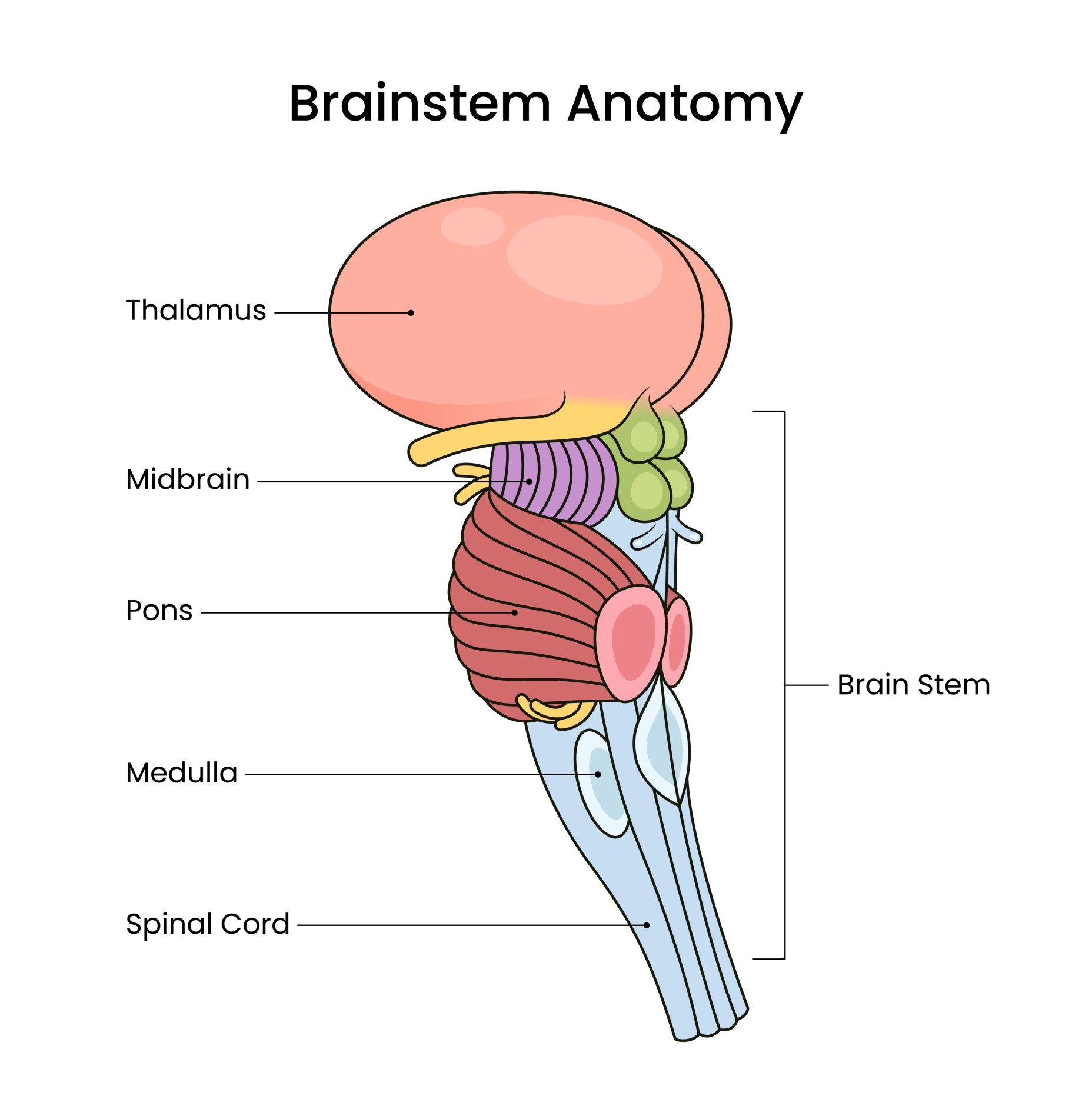
The brainstem has three major parts: the midbrain, pons, and medulla oblongata.
Each of these parts plays a different role (explained below), but together they manage functions you don’t have to think about – things like breathing, heart rate, and consciousness.
Because it contains critical nerve pathways, the brainstem also links the brain to the rest of the body, carrying messages to and from the spinal cord.
Key Takeaways
- The brainstem connects the brain to the spinal cord and regulates automatic, life-sustaining functions.
- It controls breathing, heart rate, blood pressure, consciousness, and reflexes like swallowing.
- It acts as a communication bridge between the brain and body.
- Most cranial nerves emerge from the brainstem, supporting facial movement, hearing, and swallowing.
- In psychology, the brainstem is essential for consciousness, sleep, and instinctive survival behaviors.
- Damage can result in coma, paralysis, or death, showing how vital the brainstem is to everyday functioning.
Main Functions of the Brainstem
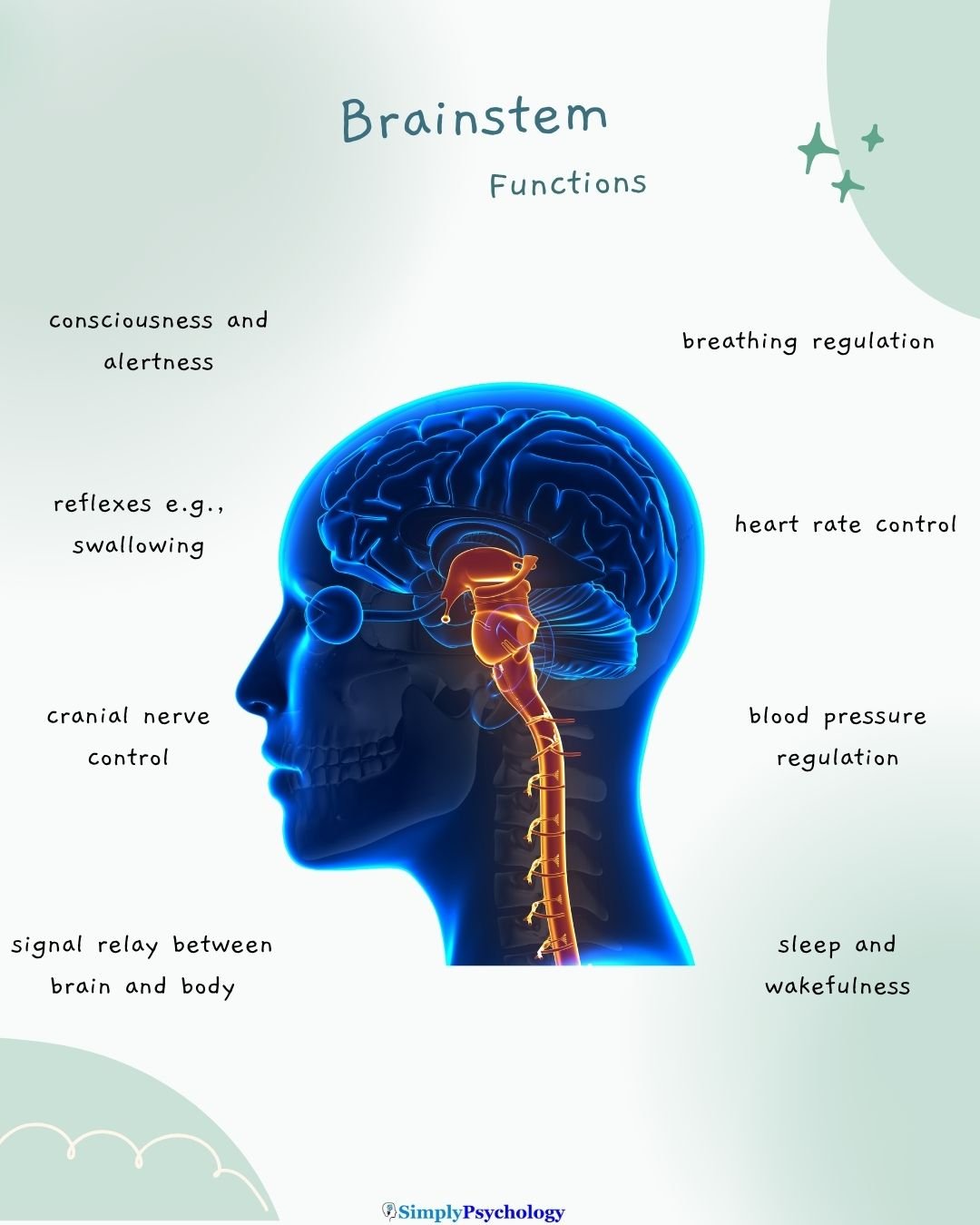
The brainstem controls many automatic, life-sustaining functions that keep us alive without conscious effort.
It works as the body’s autopilot for critical processes. Key functions of the brainstem include:
- Breathing: Regulates the rate and depth of breathing. Neurons in the medulla (with help from the pons) automatically control our breathing rhythm.
- Heart rate & blood pressure: Adjusts heartbeats and blood vessel diameter to maintain blood pressure. The medulla contains cardiovascular centers that manage heart rate and blood pressure reflexively.
- Sleep and arousal: Maintains consciousness, alertness, and sleep cycles. The brainstem’s reticular activating system (RAS) stimulates wakefulness and helps regulate the sleep-wake cycle.
- Reflexes: Coordinates involuntary reflex actions like swallowing, coughing, gagging, and blinking. For example, the brainstem triggers the gag and swallowing reflex to protect your airway, and adjusts pupil size in response to light.
- Relay of signals: Serves as a communication bridge between the brain and body. All sensory information from the body to the brain (touch, pain, etc.) and motor commands from the brain to muscles pass through the brainstem. It’s like a two-way highway for nerve signals, ensuring the brain and body stay connected.
These functions happen automatically.
You do not have to “think” to breathe or keep your heart beating – your brainstem handles it in the background, which is why it’s crucial for survival.
Parts of the Brainstem
The brainstem is made up of three main parts. Each part has specific structures and roles:
Midbrain (Mesencephalon)
This is the upper part of the brainstem.
It controls eye movements and certain reflexes to visual and auditory stimuli.
It also houses dopamine-producing neurons (e.g., substantia nigra) important for movement and reward.
Pons
The pons is the middle section of the brainstem (its name means “bridge”).
It helps regulate breathing by working with the medulla to maintain a smooth respiratory rhythm.
It serves as a bridge linking the cerebellum with the rest of the brain, and relays signals for facial movement and sensation, as well as for hearing and balance.
Medulla Oblongata
The medulla is the lowest part of the brainstem, directly continuous with the spinal cord.
It controls critical automatic functions: it regulates heart rate, blood pressure, and breathing.
It also manages reflexes like swallowing, coughing, sneezing, and vomiting. Because the medulla governs such vital processes, damage to it can be fatal.

Cranial Nerves and the Brainstem
Twelve pairs of cranial nerves arise from the brain to control the head and internal organs.
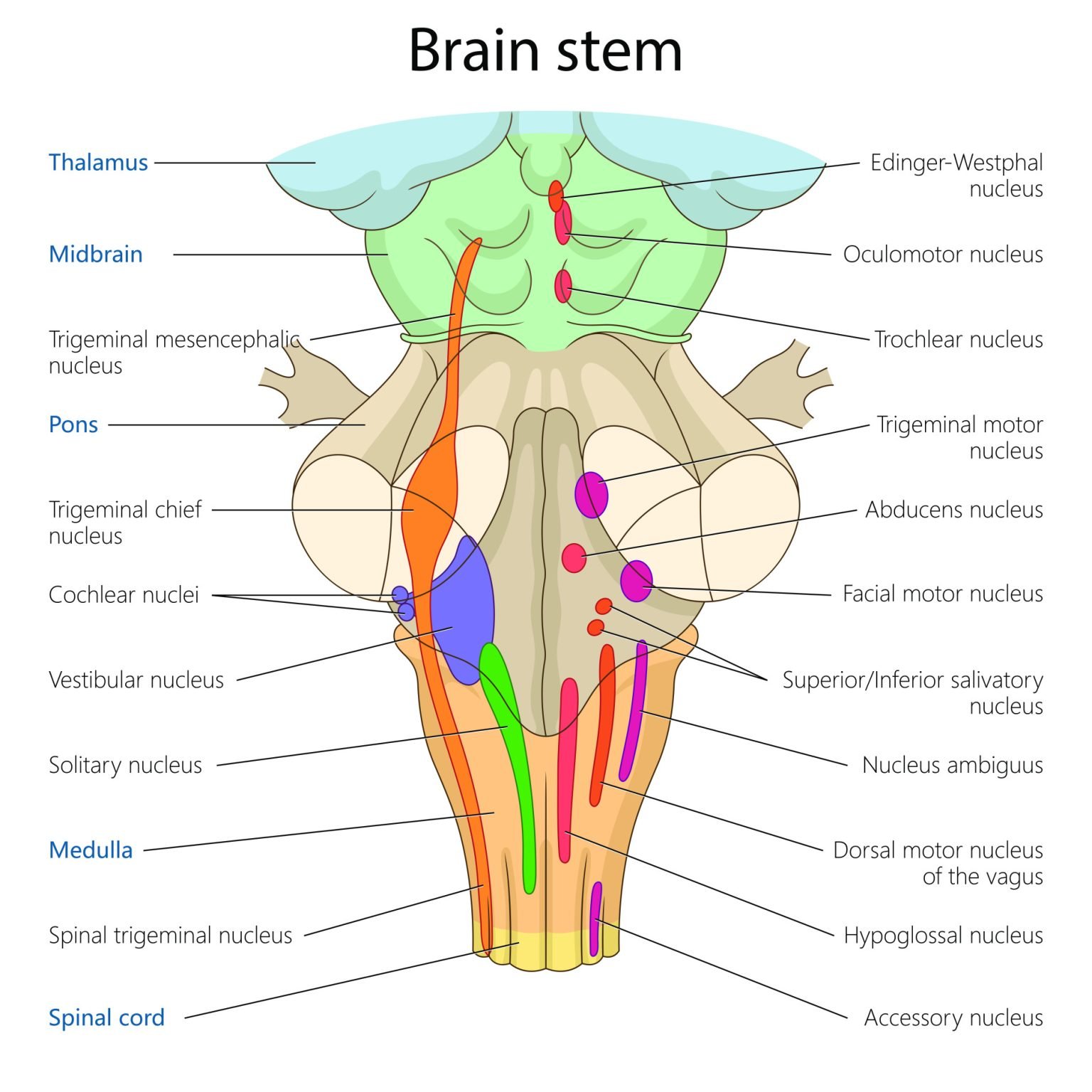
Importantly, 10 out of the 12 cranial nerves originate in the brainstem (cranial nerves III through XII).
In simpler terms, most nerves that let you blink, smile, cry, hear, taste, speak, and swallow can be traced to nuclei (nerve control centers) within the brainstem.
The brainstem acts as a command center for these cranial nerves, sending signals between the brain and the face, throat, and sensory organs.
This is why damage to the brainstem can cause widespread problems – it can affect hearing, balance, facial movements, and even basic abilities like swallowing or speaking.
Why the Brainstem Matters in Psychology
In psychology and neuroscience, the brainstem is seen as the foundation for consciousness and basic survival behavior.
The reticular formation, particularly the reticular activating system (RAS), plays a key role in alertness, attention, and wakefulness.
Damage to this area can lead to coma, as the brain’s internal “alarm system” shuts down.
Because it governs such basic, automatic functions, the brainstem is sometimes called the “reptilian brain.”
The brainstem works closely with the autonomic nervous system to produce physical reactions to emotions.
For instance, during fear, the limbic system signals the brainstem to trigger a fight-or-flight response—faster heart rate, rapid breathing, and more.
In short, the brainstem supports automatic responses that form the basis of more complex behaviors.
Without it, higher thinking processes can’t occur, making it essential for both survival and psychological functioning.
Disorders and Damage to the Brainstem
Because the brainstem controls vital functions, injuries can be life-threatening.
A brainstem stroke may cause locked-in syndrome, where a person is fully conscious but paralyzed except for eye movements.
Severe damage—whether from trauma, swelling, or disease—can result in coma or brain death.
Since the brainstem controls breathing and consciousness, damage may cause loss of awareness and inability to breathe independently.
In cases of brainstem death, recovery is not possible.
Other symptoms of brainstem damage include:
- Difficulty swallowing
- Impaired balance
- Slurred speech
- Paralysis
Recovery is often limited, and many brainstem injuries require urgent life support. Even survivors may face lasting disabilities.


ReviewerAuthor

BSc (Hons) Psychology, MRes, PhD, University of Manchester
Editor-in-Chief for Simply Psychology
Saul McLeod, PhD., is a qualified psychology teacher with over 18 years of experience in further and higher education. He has been published in peer-reviewed journals, including the Journal of Clinical Psychology.
脑干:组成部分、功能和意义
脑干是大脑的茎状下部,连接主脑(大脑)和脊髓。它位于颅骨底部,脊髓上方,被认为是中枢神经系统 ( CNS ) 的一部分。
用简单的语言来说,脑干就像身体的生命支持系统——它控制着维持生命的基本功能。
脑干由三个主要部分组成:中脑、脑桥和延髓。
每个部分都扮演着不同的角色(如下所述),但它们一起管理您无需考虑的功能- 例如呼吸、心率和意识。
由于脑干包含关键的神经通路,因此还将大脑与身体的其他部分连接起来,在脊髓之间传递信息。
要点
- 脑干将大脑与脊髓连接起来,调节自动的、维持生命的功能。
- 它控制呼吸、心率、血压、意识和吞咽等反射。
- 它充当大脑和身体之间的沟通桥梁。
- 大多数脑神经从脑干发出,支持面部运动、听力和吞咽。
- 在心理学中,脑干对于意识、睡眠和本能的生存行为至关重要。
- 损伤可能导致昏迷、瘫痪或死亡,这表明脑干对于日常功能有多么重要。
脑干的主要功能
脑干控制着许多自动的、维持生命的功能,使我们无需有意识的努力就能生存。
它充当身体关键过程的自动驾驶仪。脑干的主要功能包括:
- 呼吸:调节呼吸的频率和深度。延髓中的神经元(在脑桥的帮助下)自动控制我们的呼吸节律。
- 心率和血压:调节心跳和血管直径以维持血压。髓质包含心血管中心,可以反射性地控制心率和血压。
- 睡眠和觉醒:保持意识、警觉性和睡眠周期。脑干的网状激活系统 (RAS) 刺激觉醒并帮助调节睡眠-觉醒周期。
- 反射:协调吞咽、咳嗽、作呕和眨眼等非自愿反射动作。例如,脑干触发呕吐和吞咽反射以保护呼吸道,并根据光线调整瞳孔大小。
- 信号中继:充当大脑和身体之间的沟通桥梁。所有从身体到大脑的感觉信息(触觉、疼痛等)以及从大脑到肌肉的运动命令都通过脑干。它就像神经信号的双向高速公路,确保大脑和身体保持连接。
这些功能会自动发生。
你不必“思考”来呼吸或保持心跳——你的脑干在后台处理它,这就是为什么它对生存至关重要。
脑干的部分
脑干由三个主要部分组成。每个部分都有特定的结构和作用:
中脑(中脑)
这是脑干的上部。
它控制眼球运动以及对视觉和听觉刺激的某些反射。
它还容纳了对运动和奖励很重要的产生多巴胺的神经元(例如黑质)。
庞斯
脑桥是脑干的中间部分(它的名字意思是“桥”)。
它通过与延髓合作来帮助调节呼吸,以保持平稳的呼吸节律。
它充当连接小脑与大脑其他部分的桥梁,并传递面部运动和感觉以及听力和平衡的信号。
脊髓拉长
延髓是脑干的最低部分,直接与脊髓相连。
它控制关键的自动功能:调节心率、血压和呼吸。
它还管理吞咽、咳嗽、打喷嚏和呕吐等反射。由于髓质控制着这些重要的过程,对其造成的损伤可能是致命的。
脑神经和脑干
十二对脑神经从大脑发出,控制头部和内脏。
重要的是,12 条脑神经中有 10 条起源于脑干(脑神经 III 至 XII)。
简单来说,大多数让你眨眼、微笑、哭泣、聆听、品尝、说话和吞咽的神经都可以追溯到脑干内的神经核(神经控制中心)。
脑干充当这些脑神经的指挥中心,在大脑和面部、喉咙和感觉器官之间发送信号。
这就是为什么脑干损伤会导致广泛的问题——它会影响听力、平衡、面部运动,甚至吞咽或说话等基本能力。
为什么脑干在心理学中很重要
在心理学和神经科学中,脑干被视为意识和基本生存行为的基础。
网状结构,特别是网状激活系统(RAS) ,在警觉性、注意力和觉醒方面发挥着关键作用。
当大脑内部的“警报系统”关闭时,该区域的损伤可能会导致昏迷。
由于脑干控制着这些基本的自动功能,因此有时被称为“爬虫类大脑”。
脑干与自主神经系统密切合作,对情绪产生身体反应。
例如,在恐惧期间,边缘系统向脑干发出信号,触发“战斗或逃跑”反应——心率加快、呼吸急促等等。
简而言之,脑干支持自动反应,这些反应构成了更复杂行为的基础。
没有它,高级思维过程就无法发生,这使得它对于生存和心理功能都至关重要。
脑干疾病和损伤
由于脑干控制着重要功能,受伤可能会危及生命。
脑干中风可能会导致闭锁综合症,即一个人完全意识清醒,但除了眼球运动外却处于瘫痪状态。
严重损伤——无论是外伤、肿胀还是疾病——都可能导致昏迷或脑死亡。
由于脑干控制着呼吸和意识,损伤可能会导致意识丧失和无法独立呼吸。
如果脑干死亡,则不可能康复。
脑干损伤的其他症状包括:
- 吞咽困难
- 平衡受损
- 言语不清
- 麻痹
恢复往往是有限的,许多脑干损伤需要紧急生命支持。即使幸存者也可能面临持久的残疾。