

焦虑螺旋及其识别与应对方法
An anxiety spiral happens when anxiety feeds on itself — a single worry sparks fear, physical stress reactions kick in, and those sensations trigger even more anxious thoughts.
Imagine lying in bed replaying a mistake at work. Soon, your mind jumps to “I’ll get fired, lose my home, everything will collapse.”
Your heart races, your chest tightens, and you feel trapped in your own thoughts. This isn’t ordinary worry — it’s a loop that feels impossible to escape.
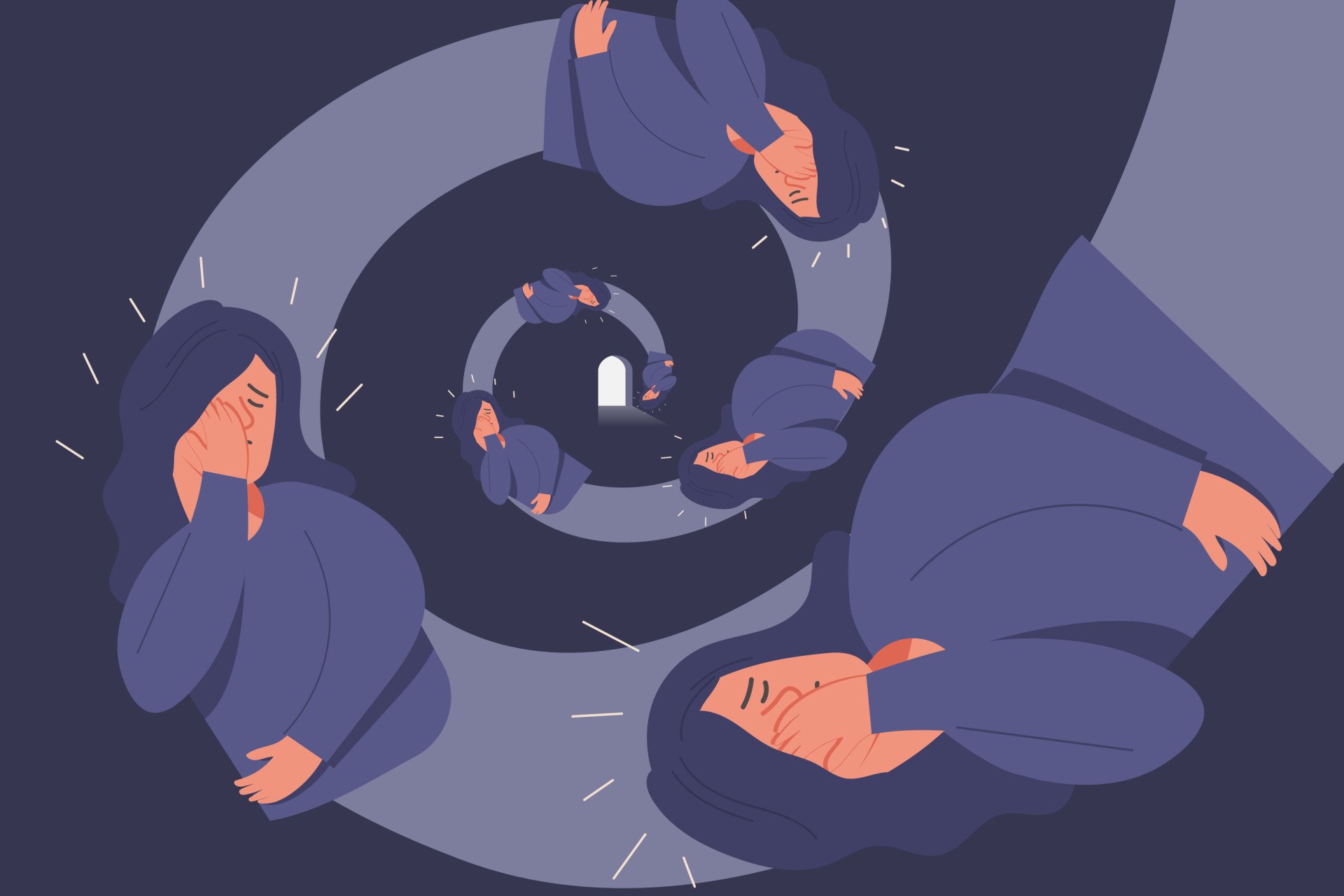
Unlike everyday anxiety, which is tied to specific concerns, spirals pull you into an endless cycle of “what ifs.”
They differ from panic attacks (which hit suddenly and peak quickly) and from OCD rumination (which revolves around intrusive obsessions). Anxiety spirals often begin with a realistic concern that escalates far beyond proportion.
“I start with one small worry, then it explodes into imagining every worst-case scenario.”
Recognizing When You’re Spiraling
The first step is noticing when anxiety has shifted from typical worry into a spiral.
- Cognitively, your thoughts may race or loop uncontrollably. You might obsess over catastrophic outcomes — “If I don’t hear back soon, something terrible must have happened” — and feel powerless to redirect your mind.
- Emotionally, spirals bring dread, irritability, or a sense of impending doom. Many people describe feeling overwhelmed, helpless, or out of control.
- Physically, the body’s fight-or-flight response activates: pounding heart, chest tightness, dizziness, sweating, trembling, or stomach knots. These sensations can be frightening, convincing you something is “really wrong,” which further fuels the anxiety.
- Behaviorally, you might withdraw, avoid triggers, or seek reassurance — repeatedly checking, Googling symptoms, or calling loved ones for comfort. While these actions offer momentary relief, they reinforce the fear over time.
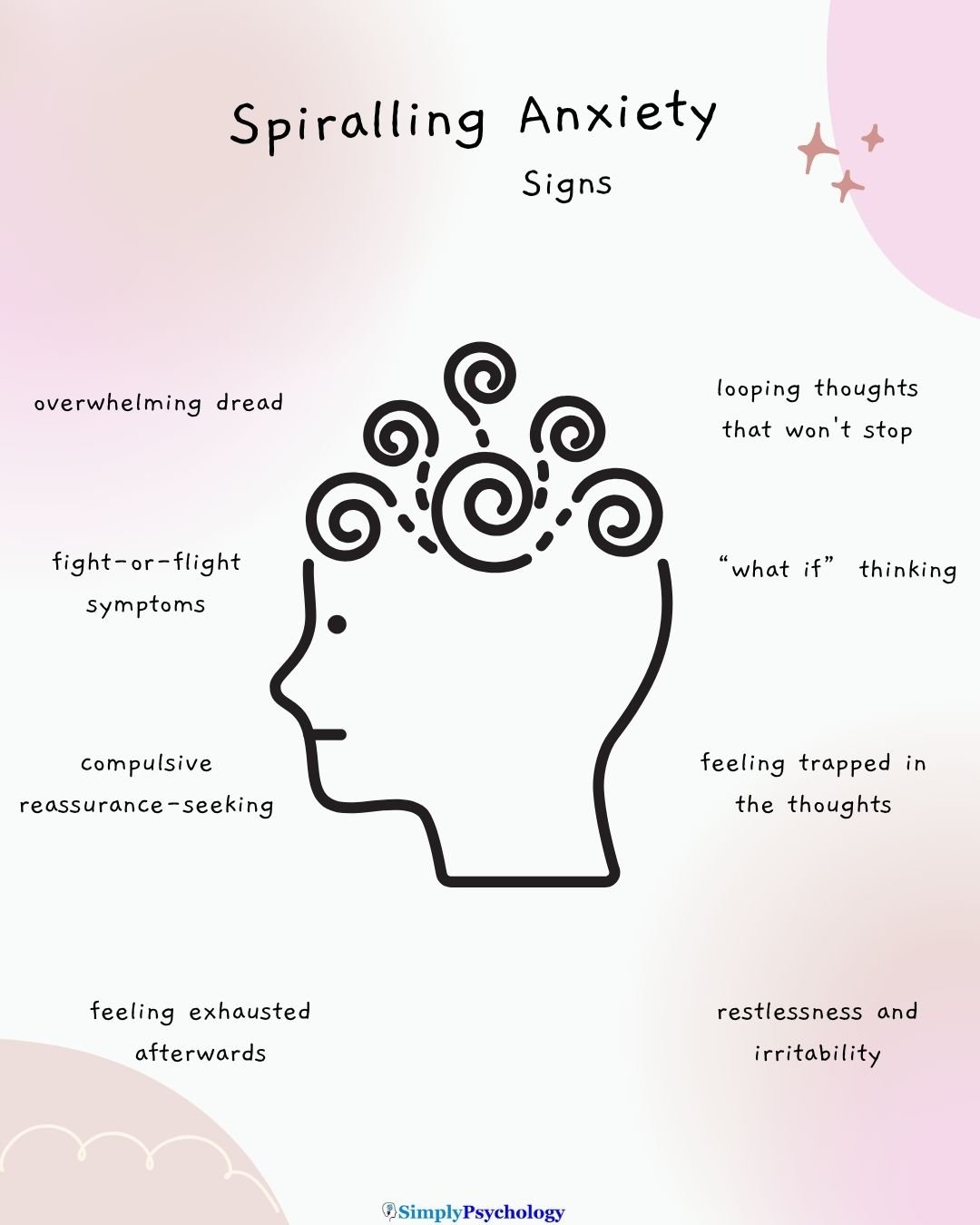
Below is a quick checklist of signs of an anxiety spiral:
- Intrusive thoughts: Non-stop “what if” thoughts or imagining worst-case scenarios you can’t dismiss.
- Intense emotions: Feeling panicky, trapped in worry, or unusually irritable and jumpy.
- Body in overdrive: Rapid heartbeat, sweating, upset stomach, dizziness, or shortness of breath without a medical cause.
- Avoidance/Reassurance: Urges to escape situations, call loved ones repeatedly to ask if things will be okay, or Google symptoms compulsively.
If you recognize several of these happening together, you’re likely in an anxiety spiral. Recognizing the pattern is the first step to stopping it.
Why Anxiety Spirals Happen
Anxiety spirals form through a feedback loop between thoughts, emotions, and body sensations.
A trigger — stress, uncertainty, or even fatigue — sparks anxious thoughts, which activate the body’s stress response.
Those physical sensations (racing heart, tense muscles) then confirm the fear, leading to even more anxious thoughts.
Common triggers include major life stressors (like exams, work conflict, or relationship uncertainty), past trauma, or even positive changes such as starting a new job or becoming a parent.
Lifestyle factors like poor sleep, excess caffeine, or alcohol use can also prime your system for anxiety.
Research from Scientific American shows that even one night of poor sleep can sharply increase next-day anxiety by impairing the brain’s emotional regulation.
Similarly, the American Medical Association notes that caffeine raises heart rate and breathing rate, often mimicking anxiety symptoms. Alcohol may seem calming at first, but as it wears off, stress hormones rebound — a phenomenon nicknamed “hangxiety.”
Modern life adds another layer: constant exposure to distressing news or social comparisons online. Psychologist David DeSteno explains that a nonstop flow of negative content convinces our brains we’re under continuous threat, heightening the risk of spiraling.
The Brain–Body Feedback Loop
Biologically, anxiety spirals are driven by communication between two key brain regions:
- The amygdala, which detects threats and triggers the fight-or-flight response.
- The prefrontal cortex, which helps assess and regulate those signals.
When you’re stressed, sleep-deprived, or overwhelmed, the prefrontal cortex struggles to rein in the amygdala’s alarm.
As a result, harmless sensations — like a racing heart — can be misinterpreted as danger. You think, “Something’s wrong with me,” which triggers more adrenaline and anxiety symptoms.
This cycle of thought → fear → physical response → more fearful thoughts can last for hours unless interrupted.
Cognitive distortions like catastrophizing (“I’ll never recover from this”) or black-and-white thinking (“Either I’m calm or I’m falling apart”) keep the loop alive.
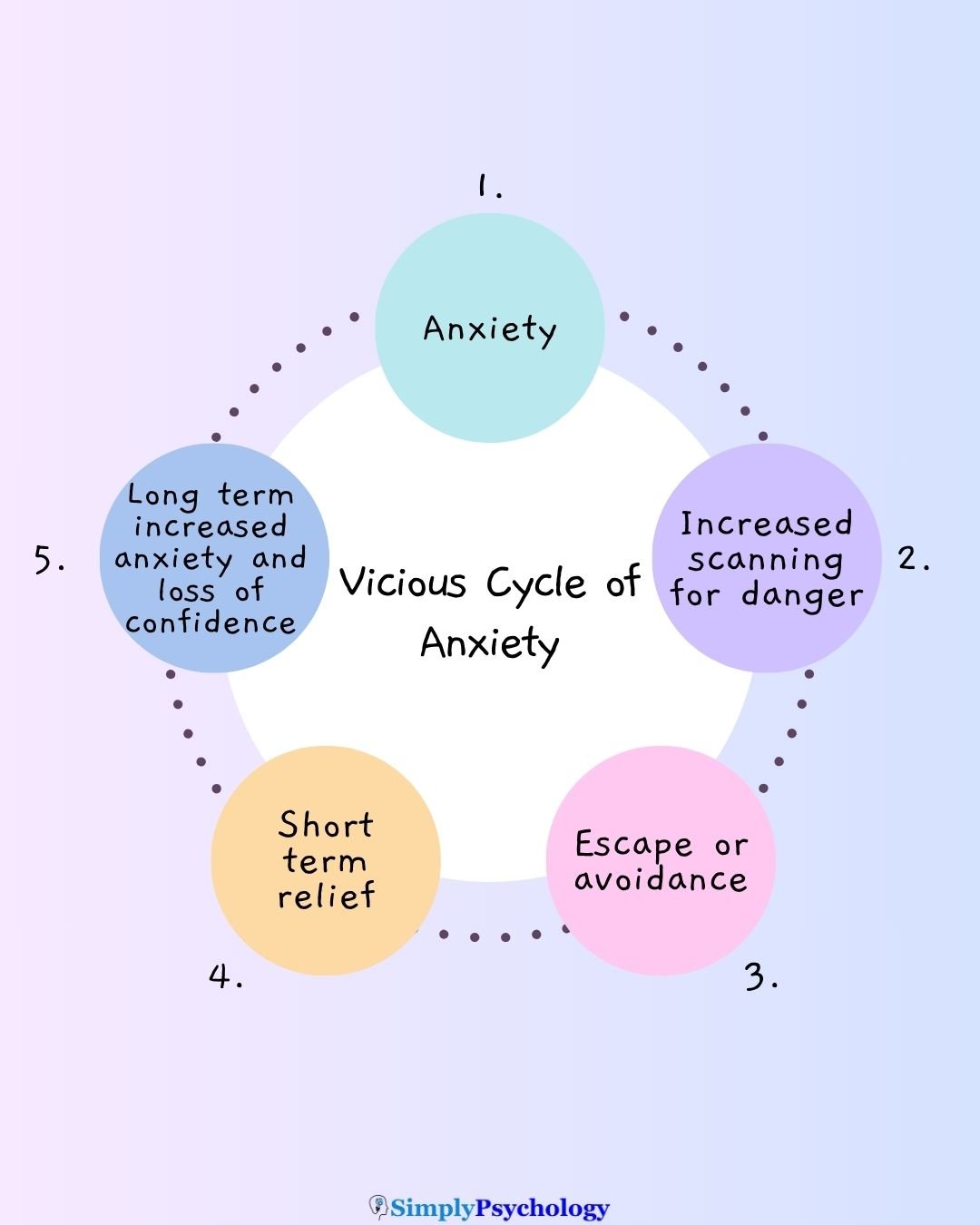
Avoidance and “safety behaviors” — like always sitting near an exit or carrying medication “just in case” — provide temporary comfort but teach your brain that anxiety is unbearable.
Over time, that avoidance reinforces the fear, making future spirals more likely.
Breaking the Cycle in the Moment
When you catch yourself spiraling, the goal is to break the loop by calming your body, grounding your mind, or both. Here are some effective tools to help you regain control:
1. Ground with Your Senses (5-4-3-2-1 Technique)
Name five things you can see, four you can hear, three you can touch, two you can smell, and one you can taste.
This classic mindfulness technique roots you in the present moment and interrupts anxious thought loops.
Clinical psychologist Ellen Hendriksen explains that bringing attention to the senses “grounds us in the present and counting the items interrupts the spinning of our thoughts.”
2. Breathe Slowly and Deeply
Anxiety often makes us overbreathe, keeping us panicky. Instead, try slow, controlled breathing like the 4-7-8 technique (inhale for 4 counts, hold for 7, exhale for 8) or simply take slow belly breaths.
Exhaling for longer than you inhale triggers the parasympathetic nervous system – your body’s natural calming mechanism – which slows your heart rate and lowers blood pressure.
Remind yourself as you breathe, “These sensations are a false alarm — I’m safe right now.”
3. Use Temperature to Reset
Splashing your face with cold water or holding an ice pack against your skin can activate the body’s “dive reflex,” lowering heart rate and calming your nervous system.
It’s a jarring sensation that yanks your body out of panic mode momentarily, giving you a chance to regain control.
4. Label Your Thoughts (“Cognitive Defusion”)
Instead of believing every anxious thought, name it: “I notice I’m thinking that I’m going to fail this test and lose my job. That’s my anxiety talking.”
By doing this, you treat the frightening thought as a mental event – not an absolute reality.
This is a technique from acceptance and commitment therapy (ACT) called cognitive defusion. It creates a little distance between you and the anxious thought, making it less believable.
5. Move Your Body
Physical activity burns off excess adrenaline and signals to your body that the threat has passed. Even 60 seconds of brisk movement, shaking out tension, or stretching can help.
Stand up, roll your shoulders back, or do a “power pose” (hands on hips, feet firmly planted) for a minute.
Adopting a more relaxed or confident posture can send signals back to your brain that you are not in danger, helping to calm your nerves.
6. The 90-Second Reset
Neuroscientist Jill Bolte Taylor notes that the physiological lifespan of an emotion is about 90 seconds — after that, only your thoughts keep it alive.
The moment you notice the telltale signs of a spiral, do a grounding exercise or deep breathing for a minute and a half. By occupying that critical window with calming input, you prevent the feedback loop from snowballing.
Building Long-Term Resilience
Breaking a spiral in the moment is vital, but preventing future ones is just as important. These long-term habits strengthen your emotional stability and reduce chronic anxiety.
1. Practice Mindfulness and Acceptance
Regular mindfulness or journaling helps you observe anxious thoughts without being consumed by them. Noticing your thoughts without judgment can build resilience over time.
Acceptance — saying, “I feel anxious, and I can handle this” — prevents the secondary panic that often fuels spirals.
2. Challenge Distorted Thinking
Identify your most common thought traps, such as catastrophizing or assuming the worst. When calm, write them down and respond with rational counterstatements.
For example: “Even if I make a mistake, it doesn’t mean everything will fall apart.” Rehearsing these balanced thoughts trains your brain to react more calmly under stress.
3. Prioritize Rest and Physical Health
Quality sleep is one of the strongest defenses against anxiety. It restores the prefrontal cortex’s ability to regulate emotions, while sleep loss amplifies anxiety sensitivity.
Reduce caffeine and alcohol, stay hydrated, and eat regularly to stabilize energy and mood. Exercise — even a brisk 10-minute walk — releases tension and boosts neurotransmitters that counter anxiety.
4. Reduce Avoidance and Reassurance-Seeking
While it’s tempting to avoid triggers or constantly seek comfort, these behaviors reinforce fear.
Instead, challenge yourself gently to face anxiety-provoking situations in small, manageable doses. Each time you do, your confidence grows — and the anxiety loses power.
5. Use Gradual Exposure
Exposure therapy, a proven cognitive-behavioral approach, involves systematically facing fears.
Start small — if social situations make you spiral, meet one friend for coffee before tackling larger gatherings.
Each success teaches your brain that discomfort is temporary and survivable, rewiring your fear response.
6. Curate Your Mental Diet
Just as your body reacts to what you eat, your mind reacts to what you consume. Try to balance stressful media with positive, calming content — uplifting shows, music, or gratitude practices.
You can’t avoid all stress, but you can prevent your brain from marinating in constant threat cues.
Getting Help and Support
If anxiety spirals are frequent or disruptive, reaching out for professional help can make a huge difference. Persistent anxiety may signal a treatable condition such as generalized anxiety disorder or panic disorder.
Therapy
Cognitive Behavioral Therapy (CBT) helps you challenge anxious thoughts and reduce avoidance.
Acceptance and Commitment Therapy (ACT) teaches you to coexist with anxious feelings without letting them control you.
For those prone to obsessive rumination, Rumination-Focused CBT (RFCBT) directly targets repetitive thinking patterns and has shown promising results in reducing both anxiety and depression.
Medication
Doctors may prescribe SSRIs to lower baseline anxiety or short-term anti-anxiety medication for acute spirals.
Always consult a healthcare provider before starting or stopping medication.
Social support
Talking with a trusted friend or joining a support group can help you feel less alone and more grounded.
Even small gestures — a reassuring text, a hug, synchronized breathing with a partner — can calm your nervous system through co-regulation.
Studies show that perceived social support reduces anxiety symptoms and improves resilience.
If your anxiety spirals ever lead to dark or hopeless thoughts, seek help immediately through a crisis line or mental health professional. You are not alone, and effective help exists.
ReviewerAuthor
BSc (Hons) Psychology, MRes, PhD, University of Manchester
Editor-in-Chief for Simply Psychology
Saul McLeod, PhD., is a qualified psychology teacher with over 18 years of experience in further and higher education. He has been published in peer-reviewed journals, including the Journal of Clinical Psychology.
焦虑螺旋以及如何识别和管理它们
当焦虑自行滋长时,焦虑螺旋就会发生——单一的担忧会引发恐惧,身体压力反应就会出现,而这些感觉会引发更多焦虑的想法。
想象一下躺在床上重温工作中的错误。很快,你的思绪就会跳到“我会被解雇,失去我的家,一切都会崩溃。”
你的心跳加快,胸口收紧,你感觉自己陷入了自己的思绪中。这不是普通的担忧——这是一个感觉无法逃脱的循环。
与与特定问题相关的日常焦虑不同,螺旋式的焦虑会让你陷入“假设”的无休止循环。
它们不同于惊恐发作(突然发作并迅速达到顶峰)和强迫症沉思(围绕侵入性痴迷)。焦虑的螺旋式上升往往始于一种现实的担忧,这种担忧的升级远远超出了比例。
“我从一个小小的担忧开始,然后它就开始想象每一种最坏的情况。”
认识到自己何时处于螺旋上升状态
第一步是注意焦虑何时从典型的担忧转变为螺旋式上升。
- 在认知上,你的想法可能会不受控制地快速旋转或循环。你可能会沉迷于灾难性的结果—— “如果我没有很快收到回复,那么一定发生了可怕的事情” ——并且感觉无力改变你的思绪。
- 在情感上,螺旋带来恐惧、烦躁或厄运即将来临的感觉。许多人描述感到不知所措、无助或失控。
- 身体上,身体的战斗或逃跑反应被激活:心跳加速、胸闷、头晕、出汗、颤抖或胃部打结。这些感觉可能会令人恐惧,让你相信某些事情“确实是错误的”,这进一步加剧了焦虑。
- 在行为上,你可能会退缩、避免触发因素或寻求安慰——反复检查、谷歌搜索症状,或打电话给亲人寻求安慰。虽然这些行动可以暂时缓解压力,但随着时间的推移,它们会加剧恐惧。
以下是焦虑螺旋迹象的快速清单:
- 侵入性想法:不间断的“假设”想法或想象您无法忽视的最坏情况。
- 强烈的情绪:感到惊慌、陷入忧虑,或异常烦躁和神经质。
- 身体过度运转:心跳加快、出汗、胃部不适、头晕或无医学原因的呼吸短促。
- 回避/保证:敦促逃离困境,反复打电话给亲人询问事情是否会好起来,或者强迫性地谷歌症状。
如果您发现其中几个问题同时发生,您可能会陷入焦虑螺旋。认识到这种模式是阻止它的第一步。
为什么焦虑会螺旋式上升
焦虑螺旋是通过思想、情绪和身体感觉之间的反馈循环形成的。
压力、不确定性甚至疲劳等触发因素会引发焦虑的想法,从而激活身体的压力反应。
这些身体感觉(心跳加快、肌肉紧张)会证实恐惧,导致更加焦虑的想法。
常见的触发因素包括主要的生活压力(如考试、工作冲突或关系不确定性)、过去的创伤,甚至是积极的变化,如开始新工作或成为父母。
睡眠不佳、过量咖啡因或饮酒等生活方式因素也会让你的系统产生焦虑。
《科学美国人》的研究表明,即使一晚睡眠不好也会损害大脑的情绪调节,从而急剧增加第二天的焦虑。
同样,美国医学会指出,咖啡因会提高心率和呼吸频率,通常会模仿焦虑症状。酒精一开始可能会让人平静,但随着酒精的消退,压力荷尔蒙会反弹——这种现象被称为“悬挂焦虑” 。
现代生活又增加了一层:不断接触令人痛苦的新闻或网上的社会比较。心理学家大卫·德斯特诺(David DeSteno)解释说,不间断的负面内容会让我们的大脑相信我们正受到持续的威胁,从而增加了螺旋式上升的风险。
大脑-身体反馈循环
从生物学上来说,焦虑螺旋是由两个关键大脑区域之间的沟通驱动的:
当你感到压力、睡眠不足或不知所措时,前额叶皮层会努力控制杏仁核的警报。
因此,无害的感觉(例如心跳加速)可能会被误解为危险。你会想,“我出了什么问题”,这会引发更多的肾上腺素和焦虑症状。
这种思想→恐惧→身体反应→更可怕的想法的循环可以持续几个小时,除非被中断。
回避和“安全行为”——比如总是坐在出口附近或携带药物“以防万一”——可以提供暂时的安慰,但会告诉你的大脑焦虑是难以忍受的。
随着时间的推移,这种回避会加剧恐惧,使未来更有可能出现螺旋式上升。
立即打破循环
当你发现自己在螺旋式上升时,你的目标是通过让你的身体平静下来、让你的思想扎根,或者两者兼而有之来打破这个循环。以下是一些可以帮助您重新获得控制权的有效工具:
1. 用你的感官接地(5-4-3-2-1 技术)
说出五种你可以看到的东西,四种你可以听到的东西,三种你可以触摸的东西,两种你可以闻到的东西,一种你可以尝到的东西。
这种经典的正念技巧让你立足于当下,打断焦虑的思维循环。
临床心理学家埃伦·亨德里克森 (Ellen Hendriksen)解释说,将注意力集中到感官上“让我们立足于当下,数数可以打断我们的思绪”。
2.缓慢而深呼吸
焦虑常常使我们呼吸过度,让我们惊慌失措。相反,尝试缓慢、受控的呼吸,如4-7-8 技术(吸气 4 次,屏住 7 次,呼气 8 次),或者只是缓慢地进行腹式呼吸。
呼气时间比吸气时间长会触发副交感神经系统(身体的自然镇静机制),从而减慢心率并降低血压。
呼吸时提醒自己,“这些感觉只是一场虚惊——我现在很安全。”
3. 使用温度重置
用冷水泼脸或将冰袋放在皮肤上可以激活身体的“潜水反射”,降低心率并镇静神经系统。
这是一种刺耳的感觉,可以让你的身体暂时摆脱恐慌模式,让你有机会重新获得控制。
4. 给你的想法贴上标签(“认知解离”)
不要相信每一个焦虑的想法,而是将其命名为:“我注意到我在想我会通过这次测试并失去工作。这就是我的焦虑。”
通过这样做,你将可怕的想法视为一种心理事件——而不是绝对的现实。
这是接受与承诺疗法 ( ACT ) 中的一项技术,称为认知解离。它在你和焦虑的想法之间创造了一点距离,让它变得不那么可信。
5.移动你的身体
体力活动会消耗掉多余的肾上腺素,并向您的身体发出威胁已经过去的信号。即使是 60 秒的轻快运动、摆脱紧张或伸展运动也会有所帮助。
站起来,肩膀向后转动,或者做一个“力量姿势”(双手放在臀部,双脚踩稳)一分钟。
采取更放松或自信的姿势可以向您的大脑发送信号,表明您没有处于危险之中,从而有助于平静您的神经。
6. 90 秒重置
神经科学家吉尔·博尔特·泰勒 (Jill Bolte Taylor) 指出,一种情绪的生理寿命约为 90 秒,在此之后,只有你的思想才能让它保持活力。
当您注意到螺旋的明显迹象时,请进行一分半钟的基础练习或深呼吸。通过用平静的输入占据关键窗口,可以防止反馈循环滚雪球。
建立长期的弹性
打破当前的恶性循环至关重要,但预防未来的恶性循环也同样重要。这些长期习惯可以增强您的情绪稳定性并减少慢性焦虑。
1.练习正念和接受
定期的正念或写日记可以帮助你观察焦虑的想法,而不是被它们吞噬。随着时间的推移,不带判断地注意到自己的想法可以增强韧性。
接受——说“我感到焦虑,我可以处理这个”——可以防止经常引发螺旋式上升的二次恐慌。
2.挑战扭曲的思维
找出最常见的思维陷阱,例如灾难化或假设最坏的情况。冷静时,把它们写下来,并用理性的反驳来回应。
例如:“即使我犯了错误,也不意味着一切都会崩溃。”排练这些平衡的想法可以训练你的大脑在压力下做出更冷静的反应。
3.优先考虑休息和身体健康
优质睡眠是对抗焦虑最有力的防御措施之一。它可以恢复前额皮质调节情绪的能力,而睡眠不足会加剧焦虑敏感性。
减少咖啡因和酒精的摄入量,保持水分充足,并定期饮食以稳定能量和情绪。锻炼——即使是 10 分钟的快走——也能释放紧张情绪并增强对抗焦虑的神经递质。
4. 减少回避和寻求安慰
虽然人们很想避免触发因素或不断寻求安慰,但这些行为会加剧恐惧。
相反,温和地挑战自己,以可控制的小剂量面对引发焦虑的情况。每次你这样做,你的信心就会增强,而焦虑就会消失。
5.使用渐进曝光
暴露疗法是一种经过验证的认知行为方法,涉及系统地面对恐惧。
从小事做起——如果社交场合让你陷入困境,可以先和一位朋友喝杯咖啡,然后再参加大型聚会。
每一次成功都会告诉你的大脑,不适是暂时的、可以克服的,从而重新调整你的恐惧反应。
6.管理你的精神饮食
正如你的身体对你吃的东西做出反应一样,你的思想也会对你吃的东西做出反应。尝试平衡有压力的媒体与积极、平静的内容——令人振奋的节目、音乐或感恩实践。
你无法避免所有的压力,但你可以防止你的大脑沉浸在持续的威胁暗示中。
获得帮助和支持
如果焦虑螺旋频繁出现或具有破坏性,寻求专业帮助可能会产生巨大的影响。持续的焦虑可能预示着某种可治疗的病症,例如广泛性焦虑症或惊恐障碍。
治疗
认知行为疗法 ( CBT )可以帮助您挑战焦虑想法并减少回避。
接受与承诺疗法(ACT)教您与焦虑情绪共存,而不让它们控制您。
对于那些容易陷入沉思的人来说,专注于沉思的 CBT (RFCBT)直接针对重复性思维模式,并在减少焦虑和抑郁方面显示出可喜的效果。
药物
医生可能会开 SSRIs 来降低基线焦虑,或开短期抗焦虑药物来治疗急性螺旋。
在开始或停止用药之前,请务必咨询医疗保健提供者。
社会支持
与值得信赖的朋友交谈或加入支持小组可以帮助您减少孤独感并更加踏实。
即使是很小的动作——一条令人安心的短信、一个拥抱、与伴侣同步呼吸——都可以通过共同调节来平静你的神经系统。
研究表明,感知到的社会支持可以减轻焦虑症状并提高复原力。
如果您的焦虑螺旋式上升导致出现黑暗或绝望的想法,请立即通过危机热线或心理健康专家寻求帮助。您并不孤单,并且存在有效的帮助。
审稿人作者
曼彻斯特大学心理学学士(荣誉)、研究硕士、博士
《简单心理学》主编
Saul McLeod 博士是一位合格的心理学教师,在继续教育和高等教育方面拥有超过 18 年的经验。他曾在同行评审期刊上发表文章,包括《临床心理学杂志》。